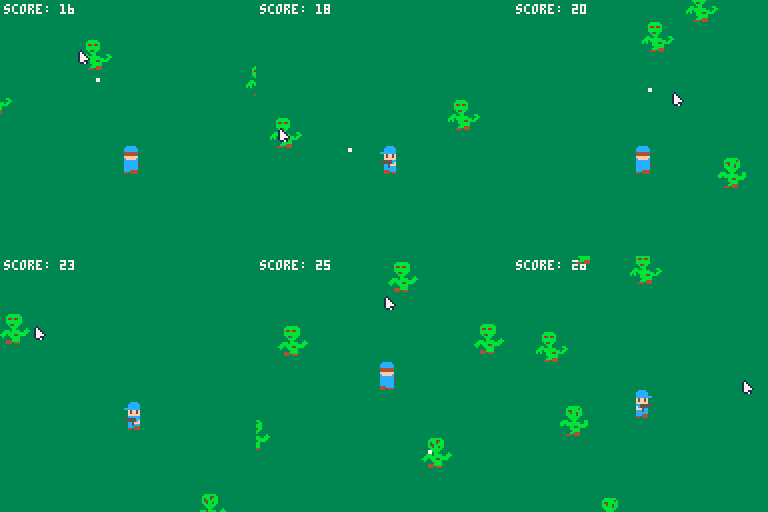
Hey guys! This is my first game I felt was good enough to post here. It's not perfect but it's pretty fun. It's a demake of a LOVE game I made.
It's MIT licensed so if you like something in it, feel free to riff or rip.
Let me know what you think or where I can improve.


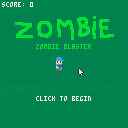
Good luck!


 4 comments









Hi all!
I am working on a small pong clone:
https://www.lexaloffle.com/bbs/?tid=29815
I am unable to solve the paddle movement jerkiness.
It is working perfectly if I move 1px per time but, if I increase paddle speed, it becomes really...
Bad.
Any suggestions?
Thanks for your time and patience :)
5 comments





Another World: SURVIVAL
Imagine the game Another World, but with endless waves of enemies to fight! (#LOWREZJAM entry)

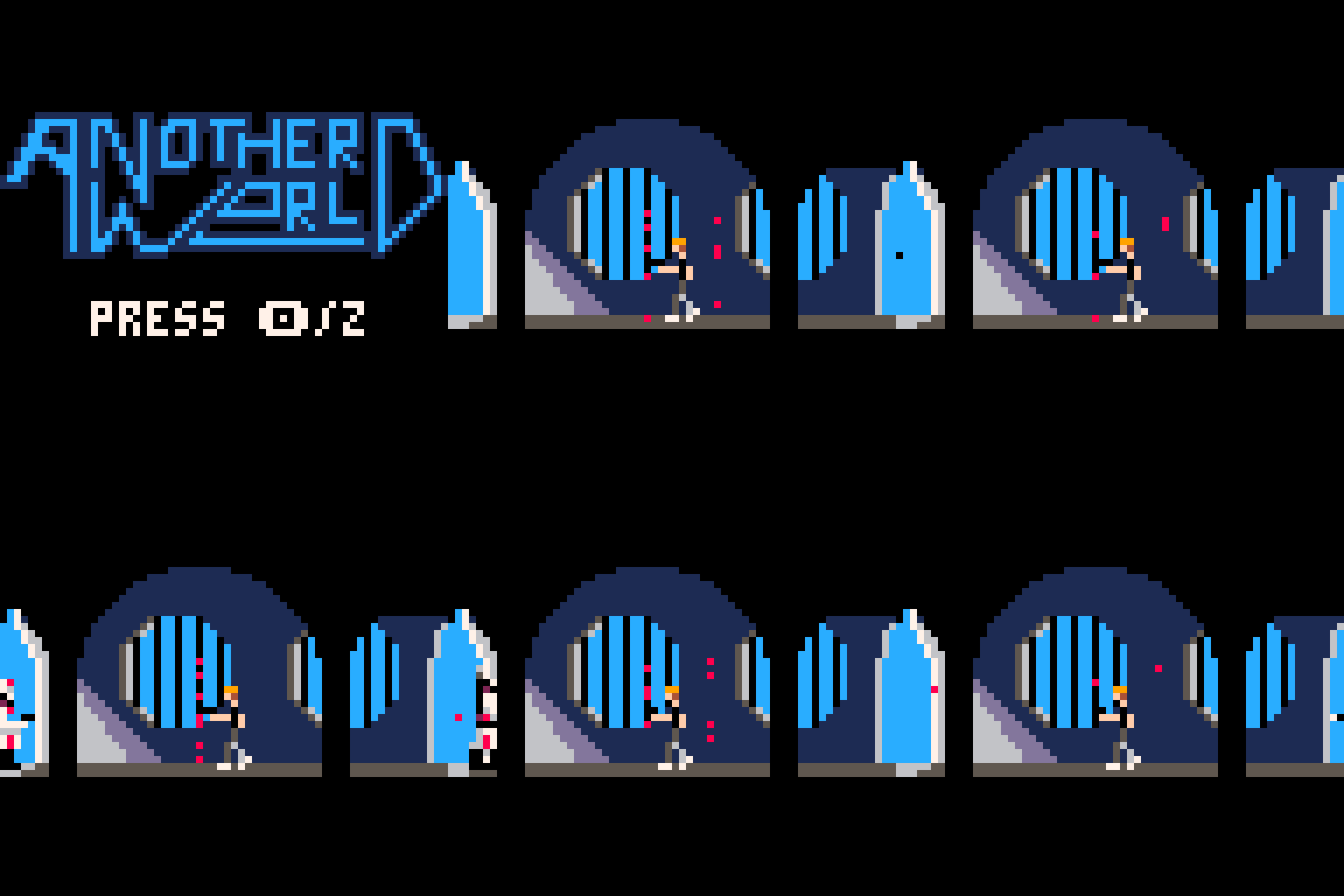
This was my entry to the #LOWREZJAM, using a display of only about 1/8th of the Pico-8 display (64x32 pixels), is a new spin on an old classic!
CONTROLS:
- Arrows = Move player left/right/crouch
- Z = Kick
- X = Fire laser - when you get the gun at Level 3
- [i](Hold for a few seconds and release to create a defence shield)
22 comments






I'd like to use a retro-styled NES USB controller with PICO-8 on Windows & Mac (and Raspberry Pi, eventually). The ones I've found so far on Amazon all have terrible reviews, though. Any recommendations for a good USB retro controller?
6 comments







I'm working on the classic memory matching card game, Concentration. My work-in-progress is below, but I have a beginner question regarding best practices when coding on the Pico-8.
The grid of cards is currently maintained using a 2D Lua table with each cell containing a few properties such as the picture to display and whether it's flipped or not. This is working well enough, but... I could just as easily store the card faces in the Pico-8's map data. The same goes for the collection of cards collected by each player. In fact, this game doesn't need to store any values greater than can be fit into 8 bits so I could potentially store all data this way. I'd simply be exchanging Lua table lookups with memory reads and writes.
I guess my question to more experienced coders is whether leaning on Lua data structures or Pico-8 memory structures is preferred? I don't expect that there is one simple answer to that, but are there pros and cons I might not be aware of after having read through the manual a few times?
9 comments






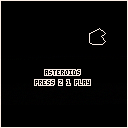
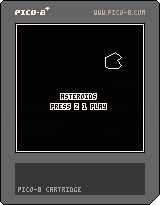
Asteroids!
A clone made by @mccolgst
Press Z to start or to fire
Left and Right Arrows to aim ship
Up Arrow to thrust
Still new to game development, and I didn't realize how much I was getting myself into by making this 'simple' clone! Learned a bunch of cool stuff about geometry and a lot of cool and interesting features in pico8 (like how the sin and cos functions work) Very fun!
5 comments


I figured out that you can use strings to set up a lot of content cheaply, and I understand that others are using procedural generation to get the same effect. All well and good, but that only works for static content. If you want a longer game where you can make changes that persist across sessions then the 256 byte limit on permenant storage is crippling. The game I want to make is basically impossible unless I use two or three extra carts JUST for their quarter-of-a-kilobyte save space. That seems a bit silly, especially since I'll be punished for it by not being able to use the BBS.
Could we get a little more room, please? Keep in mind that even carts for the original Gameboy could potentially have up to 8K of save space. I don't think that allowing 1K would violate the spirit of the PICO-8, and it would open up a lot of possibilities.
21 comments



Hello,
I am a French developer who recently discovered PICO-8.
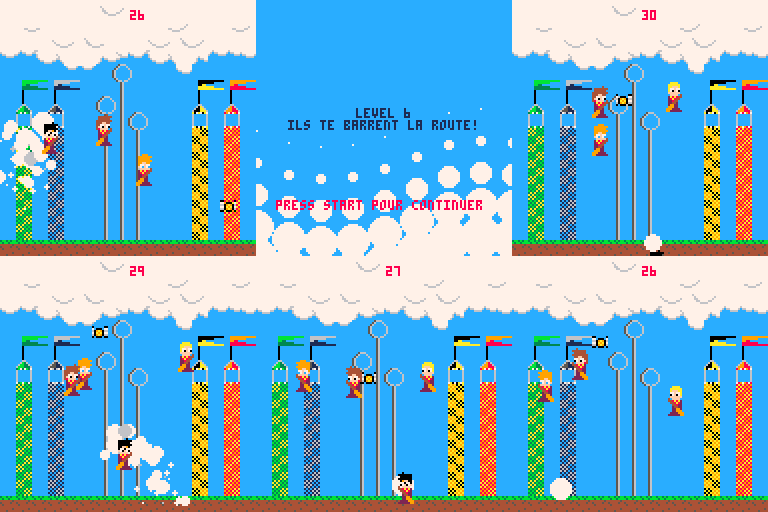
To celebrate the 20th anniversary of the release of the Harry Potter book, I designed a small game called HARRY POTTER QUIDDITCH.
The game is quite simple. You have to move Harry Potter with the Left, Right, and UP keys. You have to catch the Golden Snitch in less than 30 seconds. There are a total of 7 levels. Be careful, from the level 3, avoid touching the other players, otherwise the game is over.
For more fun, the game works with the Space Bike. This is an exercise bike that works with an electronic Makey Makey cardboard. The game will be playable for the general public from 14 to 28 October 2017 at the Françoise Sagan library in Paris.
 2 comments



How does one make a player constantly animated?
Context: I am attempting to make a sandbox game about a honeybee. I need the honeybee's wings to always be in motion.
2 comments

Hint: Tapping the button in the air will get you further horizontally than holding it.
Version 1.1: Fixed a screen that could lead to a softlock
I'm not sure how to reply to peoples comments directly in this forum so until I figure out how just know that I am overjoyed by your kind words. Thank you all so much! Your awesome!!
11 comments








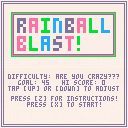
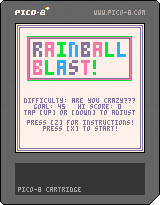
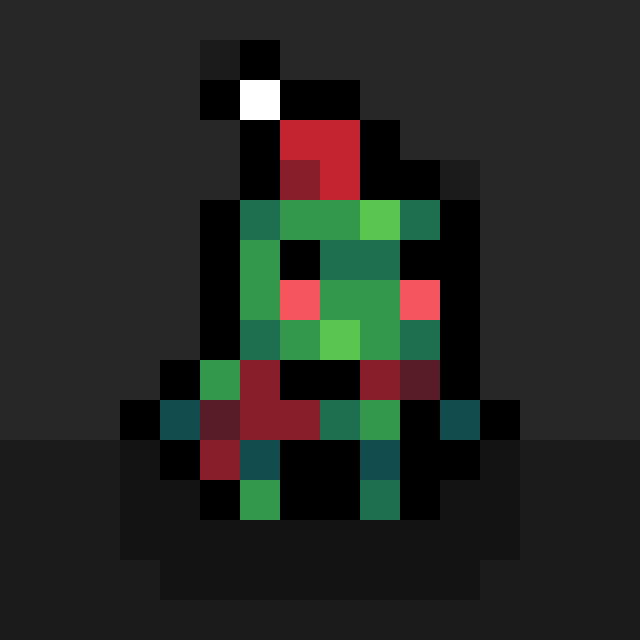
R A I N B A L L
B L A S T !
Harness the power of color!
Collect hats!
Be a sentient blob!
If you can reach the goal score for each level, you can play the level with a cool hat! Reach the goal score in all four modes to become a Rainball Champion!
1 comment

I can never resist an opportunity to mess around with regular expressions, so here's my attempt at a code minimizing script.
https://github.com/centuryglass/phantasos/blob/master/minimize.pl
If you already have perl installed, you just need to run 'perl minimize.pl yourcode.p8'. It will output the minimized code to 'yourcode_min.p8". Token mappings are also saved as 'yourcode tokens.txt' to make debugging easier. I've only tested it with my game and a few random carts. Let me know if it doesn't work on your code, I'm sure there are a couple obscure reserved words and odd failure conditions I've missed.
1 comment
Greetings all,
New PICO-8 customer here. I've been going over the manual and I'm a bit confused about something. In the Memory section it says "Colour format (gfx/screen) is 2 pixels per byte," which implies 8-bit. But in the Lua Syntax Primer section it says "Numbers in PICO-8 are all 16:16 fixed point," implying 32 bits. In that case you should be able to store 8 pixels-worth of color data per byte.
So what gives, exactly? Can I POKE 32-bit values into sprite/map slots for extra data storage?
11 comments


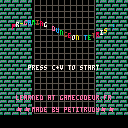
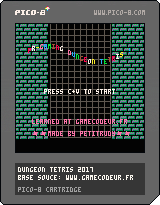
Welcome to the Dungeon Tetris !
Could you survive to the twenty level of a remake of Tetris ?
Use the arrow key to move and turn your pieces !
Base code from lesson at www.gamecodeur.fr acdademy by David Mekersa.
Post your best score on the page !
Coded in PICO-8 by Petitrudy from PR-Gaming Studio
Bienvenue dans Dungeon Tetris !
Pourrez-vous survivre aux vingt niveaux de ce remake de Tetris ?
Utiliser les touches de la croix directionnelle pour déplacer et faire pivoter vos pièces.
Poster votre meilleur score sur la page !
Le code source est tiré d'un atelier www.gamecodeur.fr par David Mekersa.
Codé en PICO-8 par Petitrudy - PR-Gaming Studio
2 comments


Just a little demo for evoke 2017. I had 3 months to learn how to code and do stuff besides making music. It was fun and I think I'll do one more. :)
Don't sweat it, if you're confused by the content, since it contains a lot of jokes towards the organizers of the party.
Got a lot of help from looking at other peoples code in the forum and the discord. Thank you for bringing me from "I can do music" to "I can make a Lambodino drive towards Cologne"! <3
4 comments



I recently tried to implement an enum structure in Lua, which turned out to be very useful. So I thought I might share it here :)
Find the latest version here (it's part of a Pico-8 library) https://github.com/sulai/Lib-Pico8/blob/master/lang.lua
Then enum(...) function generates an enum structure from a list of names.
The generated structure is useful when it comes to readability and object orientation.
As a use case for Pico-8, you can comfortably generate named objects that map to sprite ids. So if you want to associate names to your sprites like "sword", "shield", etc to show that to the user, this is a nice way to do it.
Example usage in a RPG:
tiles = enum( {"grass" ,"water", "rock"} )     -- landscape sprites start at 1
items = enum( {"sword" ,"shield", "bow"}, 16 ) -- item sprites start at 16
colors = enum( {"black", "blue", ... }, 0 )    -- map color palette.
actions = enum( {"look", "take", ... } )       -- just an enum.
|
5 comments