Going to use this post to keep track of PICO-8 related links I may want to reference later
INPUT
Input layout


 0 comments


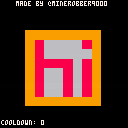
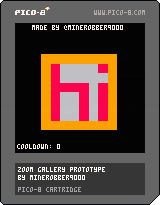
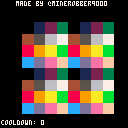
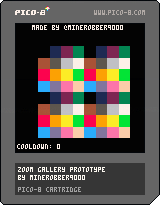
This is a WIP Pico-8 art gallery. The "cooldown" in the bottom right hand corner is how many seconds you need to wait before pressing Z to change the sprite.
Changelog:
Version 0.1.1:
- Now with scaled scrolling speed!
Planned Features:
- Cooldown timer only showing during cooldown time
- Sprites next to each other instead of using a button to swap them
- Better documentation
1 comment


I might be mistaken, but it seems like the special characters for buttons aren't working after upgrading to v0.19 of Pico-8.
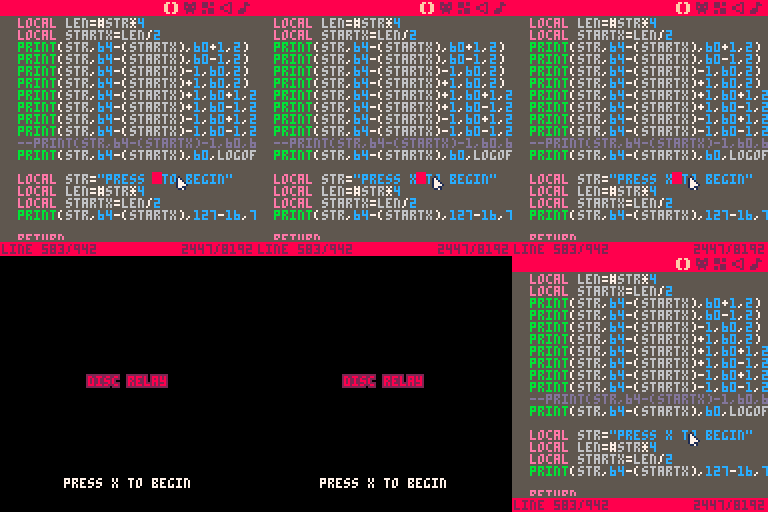
Shift+LRUDOX all show just the regular characters. Did something change (the manually still says that is how to use them). Or maybe something is busted on my end. Can someone else confirm this is broken/working?
Thanks!
Matt
7 comments





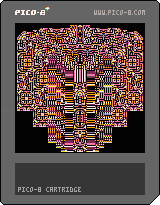
My first post here! Thanks to everyone who posts here, I have learned so much from you.
This is a little graphics thing I made on the PocketCHIP while trying to get to grips with cellular automata.
Use arrows while holding one of the action buttons to change palettes, display modes, or regenerate a new pattern. Use arrows while holding the other action button to smear the patterns into stripes.
Features:
Memory poke trick to create reflections
Modification of Conway's Game of Life from Pico-8 zine issue 2
5 comments



In Exploding Birds you, a lonely bowl of rice, feed hungry birds... TO DEATH! All the while avoiding their unending stream of poos.
You start with a limited number of rice in your bowl, if your bowl gets pooped in, you lose some of that precious rice, so make the most of your limited resources to get a high score!
Features yet to be implemented:
- Sound effects and Music
- Powerups! Become a box of Alka-Seltzer or Rocket Launcher and actually explode the birds.
- High Score tracking
Inspired by: https://twitter.com/gameideamachine/status/760550740603592704
5 comments

I am understanding that you can tell a 'variable' to mimic a command, thus:
r=rnd print(r(6)) |
I am wanting to know how to code this, preferably using only one 'variable' and without making it a function:
a=rnd b=flr(a)+1 print(b(6)) |
How would you do it ?
10 comments





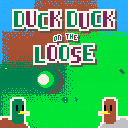
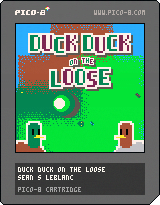
Uh oh, a flock of ducklings has gone missing, and it's up to Duck Duck to save the day! Can you help them find all seven?
I mean... it's not really your responsibility. I'm sure they'll be fine on their own. Why don't you just take some time to wander around and enjoy yourself? And hey, if you happened to find some ducklings along the way, that's cool too.
note: the web version on the BBS won't work because the module's TOTAL_MEMORY is too low, but I've included the cart here so you can still download it if you want. If you want to play it online I recommend the itch.io version.
 15 comments









Could someone please post a fully working example program making use of the CSTORE command and how to maintain user saved data even if the version changes by creating a 2nd file as the instructions hint at ?
8 comments
Just starting out. So much to learn in PICO ! Just found out today that <> is not recognized, no, you must use ~= ... Screwy !
I'll be working on this cart quite a bit now and when done, hopefully it will be an effective notepad and maybe even give you some good ideas on coding and design. :)
5 comments


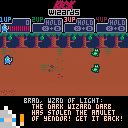
Straight from the back of a pizza parlor circa 1995, Kick Wizards is a 4 player beat-em-up styled after the TMNT and X-Men arcade games.
Tap the attack buttons to do quick attacks, hold them to charge the spells. With multiple players, if someone dies, charge a spell near their gravestone to ressurect them. Charging spells near healing crystals will gain you back some HP.
I've been working on this cart for about a month and a half; I started work on it just before The Lair was released. Hopefully there's room in the pico-8 universe for two D&D-themed beat-em-ups.
I'm currently working on finishing up the final boss behavior and building up a couple more levels of maps, but it's getting to be very very slow going since I am continually running up against the token limit. Each new feature requires a substantial refactor in order to open up 50 or 60 tokens. Minification pros, if you want to take a spin through my code and let me know if you see any easy wins, I'd appreciate it.
Otherwise, let me know what you think. I'd especially like to hear about playtests with 2 or more players, that aspect of the game has had way less testing than single player.
5 comments




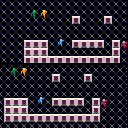
I'm going to keep this consolidated to one thread hereout.
This cart is a sampler of basic game functions that I find useful and others might want as well. I'm using these carts personally as a launchpad for more complex game mechanics.
In this cart, you will find functions and methods for:
Storing entities in tables
- One or Two players
- Single Screen or Split Screen
- Scrolling Maps
- Basic Map Tile Collision
My wishlist of things to add (but not until I have a clean method for it):
- Entity collision
- Particle effects
Again, I'm doing this to help myself, but hopefully I can help others. If you see a function or technique you think would be a valuable contribution, or a cleaner way of doing the things I've done, by all means! Make another version of the cart and load it to the thread!
4 comments


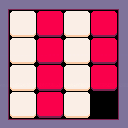
What I'm aiming to build is a sliding number puzzle, having recently bought a small plastic one at a novelty store/truck stop and remembering the simple fun of such puzzles as I solved it over and over again in the car. What I hope to is finish this cart, and then use the 15-tile sliding mechanics to create a new, more interesting game. perhaps a dungeon-crawling RPG, or something in the vein of the "Dungelot" series of games on iOS.
This cart is very nearly nothing at all. I'll be honest: I really just want to work on this some more on another PC, as well to test the new SAVE/LOAD @CLIP feature. What little programming there is is probably insanely messy and childish (I'm still blindly learning how to program with Pico-8, almost-exclusively through trial-and-error), and there are literally only three sprites, which are all of them no more than glorified squares.
If you think you can use this nearly-nothing for something, have at it, though!
1 comment








Reading about the educational license on the site it says:
"...allowing users who are teachers or administrators at a school, workshop, or other educational space to install and use the software on any computers in that space."
So, does that mean my existing license for PICO-8 is valid to use with my students at school, or do I have to purchase a new copy specifically tied to my school email address to use in school?
Thanks!
4 comments



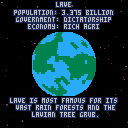
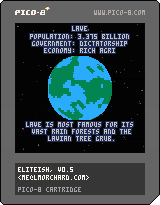
Update v0.5: Quick fix to make the auto-switch timer work again
Update v0.4: Got the goatsoup planet descriptions correct for most planets. A few have drift where names are generated randomly. Sped up & improved planet texture generation
Update v0.3: Realized I was generating Galaxy 2 for Elite. Small tweak, and now we're in Galaxy 1 starting with Lave! The goatsoup planet descriptions are still wrong, though.
Update v0.2: Added a timer to switch planets automatically every 15 seconds, so I can use it as eye candy on my PocketCHIP on my desk
Use left & right to switch planets. Buttons z & X control the speed of the star field.
Mainly a tech demo / experiment, right now. I took the C code behind Ian Bell's "Text Elite" and gave a try at translating it into Lua. From there, I dropped in some star field and rotating planet code. That makes for a little info display on imaginary planets for some eye candy.
5 comments










Hi everybody!
It's been some time since I posted around here, and worked with Pico8 in general. Was a tough summer. But I come back with a second wind, partly because of the arrival of my PocketC.H.I.P.
Last Friday I started a project while I was on a train, to test out the device and how comfortable was to actually code with it. And I decided to post here some updates about the development of said project. So, without further ado:
--------------------------------------------------------------------------------------------------------------------------------Behavior Trees
Most of you probably know about them, and have worked with them. For those which do not, I'll provide a quick explanation. Please correct me if I'm wrong, as I'm by no means an expert in this matter.
The Behavior Tree is a model widely used in the videogame industry to create goal-oriented plans using small, self-contained, behaviors. They came out in a conference about Halo 2 AI systems, and since then they've been used in lots of different projects, even outside of the domain of videogames (robotics, etc).
A behavior tree(BT) works by going through its nodes, from the root towards the leaves, computing these nodes according to certain rules.
The possible outcome of a node Tick() function is either Success, Failure or Running (usually). Each node computes its Tick() function analyzing the outcome of its own children.
e.g: The Inverter node's Tick() will return Success if its unique child returns Failure, and Failure if it returns Success.
So, in each Tick() (usually inside an Update() function), the tree will be computed and only some behaviors will activate, creating a composed, more complex, behavior.
If you're interested in reading more about them, here are a few nice links to articles and posts:
Gamasutra Article
6 comments