


Hello! I was wondering if anybody can help me figure out why my code wont delete an object. This is my first time using del so I'm sorry if it is really obvious.
trigger:
function update_slash_p1()
for s in all(slash_p1) do
s.dx+=1
if s.dx>8
then
kill_slash_p1()
end
end
code:
function kill_slash_p1()
del(slash_p1,
dx,
frame,
flip,
damage
)
end
I also tried:
del(slash_p1,{
dx,
frame,
flip,
damage
})
end
Thank you!


 3 comments

.png)


Hello, You might have seen my new celeste mod demo, resorte. I have completed all of the features I would like to have, and the only thing left is level design. The problem is my levels are pretty bad. I currently have 4 levels, but they seem bland and the difficulty is wildly different between these four. Does anyone have any tips for designing levels?
3 comments
.gif)




This is a ZX Spectrum inspired platform game where you are tasked with collecting all the coins in a level before proceeding to the next one.
The hardest part of developing this was emulating the ZX Spectrums 'colour clash' (which limits only 2 colours to an 8x8 cell) without tanking Pico 8's framerate.


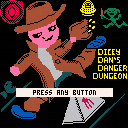
It also comes with a retro-inspired manual (which can be found here: https://geeitsomelaldy.itch.io/dicey-dans-danger-dungeon )
Text Transcript:
HOW TO PLAY
6 comments






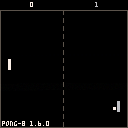


Uh oh! Due to inflation, your restaurant is going under! Luckily, there are some less ethical ways to get food- the nuclear waste sewers! Fight monsters to save enough cash to save your restaurant!
Use arrow keys for movement, x to throw a knife, and z to jump.
2 comments




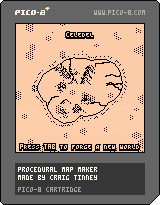
A simple 1-bit procedural map generator with coastlines, rivers, mountains and forests.
Controls
⬆️⬇️⬅️➡️ - Move camera
❎🅾️ - Zoom in an out
TAB - Enter forge, create a new world
This started life as a tweet cart and creeped in scope a bit until it became what you see now.
There's a UI to play with the numbers, if you'd like to modify these values outside the boundaries I've set, check out the vals object array near the start of the file.
The world is created from a vornoi diagram, mountains are placed along cell boundaries and forest in cell centre points.
5 comments






Feature Overview
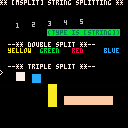
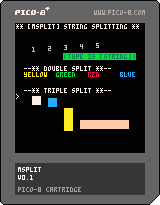
MSPLIT() Converts a string into a table by splitting it with multiple delimiters.
- The default delimiter is " " for ease of data entry and readability(according to one's own preference).
- the default delimiters and numeric conversion flags should be modified according to your project.
- This function consumes 36 Token.
-- Split a pair of data and further split it into colors and names. local value=msplit( '10-yellow 11-green 8-red 12-blue' ,' ','-' ) for i,v in pairs(value) do local col,name=unpack(v) ?name,i*32-24,48,col end |
If you want to check the type at once, consider using a DMP().
0 comments

Copy/paste is super cumbersome when using web exports on Mac. It appears that to reliably copy, I have to press ctrl-C and then cmd-C after text is written to the clipboard, and to get pastes to work I have to press cmd-V and then ctrl-V for PICO-8 to pick up the paste.
Is there a better way to do this? If not, can Mac exports be updated to only need cmd-C and cmd-V? I'd love to cut down the instructions on Tiny Drops...
It looks like this also may be affecting folks using the EDU edition: https://www.lexaloffle.com/bbs/?tid=51921
2 comments


Below is a sequence of images of the problem I am facing.
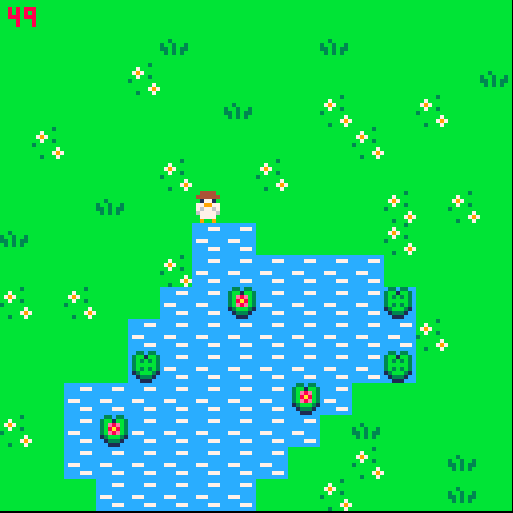
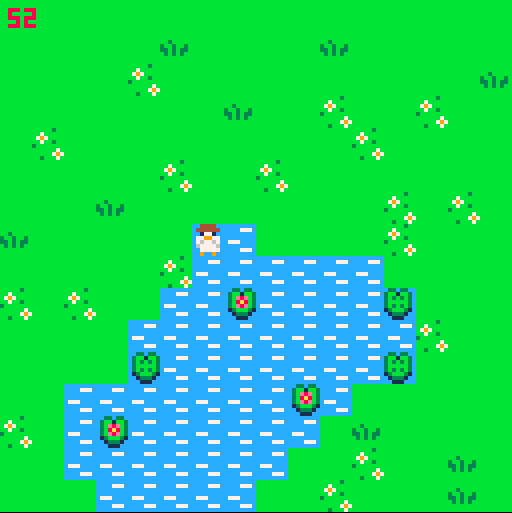
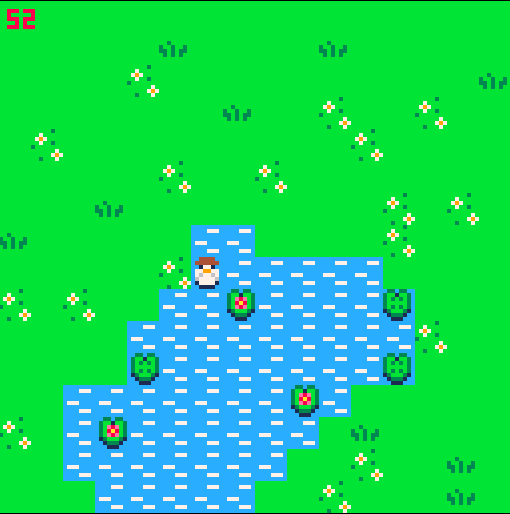
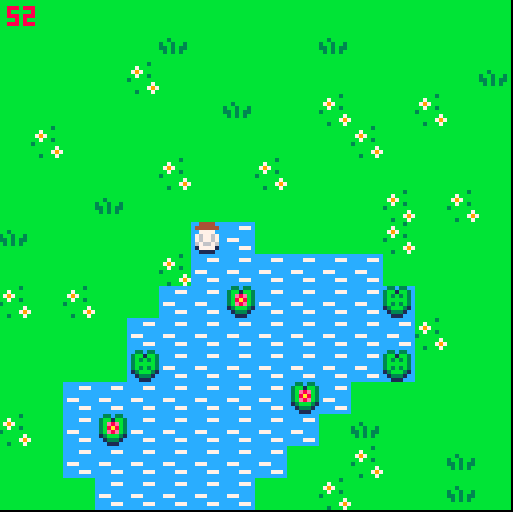
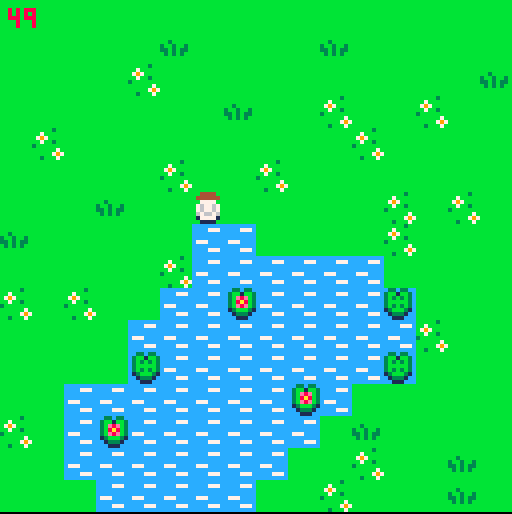
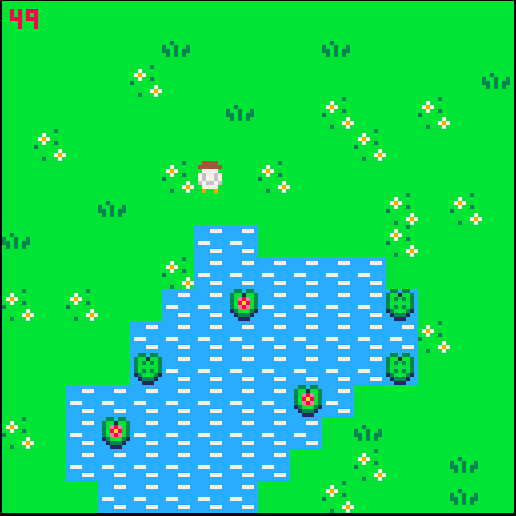
I use the mget() function to return the sprite value, but when it changes the numeric value, it doesn't change the sprite automatically.
As shown in the images, it changes only after the character is on the second block of water, and the same thing happens when he comes out of the water, as if there is a delay.
Does anyone know how to resolve?
I'll leave the cart for you to help me
 3 comments



Yet another celeste-classic like!
It's very difficult but I think some people can beat it :)
Also please let me know of any save data issues or game breaking bugs (I know of some minor ones that I left it).
15 comments







slit animation
Probably just the start of some graphical experiments.
Improvements to the animation could still be made, but it's a start.
The code is also still messy and could use some cleanup.
This works like a slit animation.
0 comments




.jpeg)


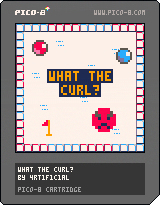
Hello! This is a small game I made for a school physics project.
It is heavily inspired by WHAT THE GOLF? and WHAT THE BAT? by Triband.
It features a tutorial, 4 levels, 12 total gags/sublevels, and a boss fight.
I built it on top of zep's collision demo but modified it to account for mass and elasticity (still not very accurate though).
2 comments

I need a command line tool to get token count. Since pico8 has the info command, I'd love to see a command line flag to load a cart and print out the info.
$ pico8 -i cart.p8 file: cart.p8 tokens: 604 / 8192 chars: 5322 / 65535 compressed: 2657 / 15616 |
0 comments
Celeste Midnight
Welcome to Celeste Midnight! In essence, this is a harder version of Celeste. I added a Deathless mode, a way to show hitboxes, a skip level function, and some TASing capabilities in a new code tab. Have fun! :)
24 comments




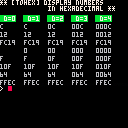
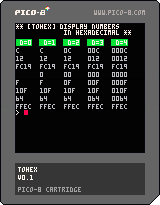
Feature Overview
TOHEX() Converts to a hexadecimal string filled with zeros.
- If the number of digits is not specified, specify 0.
- The maximum number of digits specified is 4.
- This function consumes 40 Token.
?tohex(32)   -- 20
?tohex(32,3) -- 020

?tohex('0x32',1)   -- 32
|
This function is included in the KNUTIL library.
release note
0 comments
To commemorate the release of the Teenage Mutant Ninja Turtles Arcade core on MiSTerFPGA, I decided to whip up this little cover. I was so excited to get it done, but ended up throwing it out and starting over, missing my mark...
Anyway, Here it is for everyone to listen to.

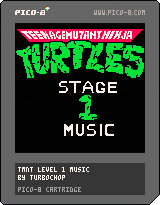
Please let me know what you think!
P.S.
Logos are really hard to draw with a trackpad... :)
Updated 09/12/24
Revisited this track for better flow. I suppose its true what they say: Projects are only abandoned, never finished.
0 comments
Somewhat proudly presenting...
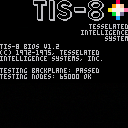
TIS-8
Introduction
This is a demake of possibly the least visually compelling and overall ill-suited games to port to Pico-8; TIS-100!
If you are familiar with Zachtronics games (and frankly why wouldn't you be?), you will be aware of this game already but in case you aren't, here's a (non-manual) way of explaining what it is:
TIS-100 is a virtual computer system produced in 1972 featuring a multiple-core architecture. Basic Execution Nodes can have up to 16 lines of assembler-esque code written into them and data is passed from one core to another. Each core only has one accumulator register and a non-interactable bak register. There are also Stack Memory Modules which can have up to 16 numbers pushed to and popped from them. The goal of the game is to read the instructions for each level, take the inputs from the top and using the nodes and modules, output the correct values at the bottom.
12 comments





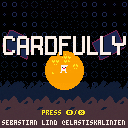
Introduction
You crashland after being a sleep for thousands of years.
You rather go back to sleep again, if you are being honest to yourself...
So go out there and reach for the stars!
⚠️ BTW THIS GAME IS HARD 🔥
Controls
Arrow keys or dpad.
Z/X keys or A/B buttons
Credits
Sebastian Lind
Made for #PPJJGG Game Jam
Theme: PENALIZED
Update 1.1
- Added a tutorial section in the pause menu
Update 1.2
- Added an indicator that somewhat points where you end up
- Lowered the time for each card action a bit
7 comments

