


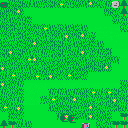
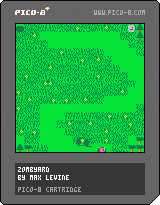
My first Pico-8 cart. This took me probably way longer than it should've to make, but I learned a lot along the way about Pico-8 and Lua. If you can think of a cleverer name than "Zombyard," please let me know. I may update the game with more levels, but right now there are just 10. Hope you enjoy!
For more games, visit maximilio.itch.io.


 0 comments


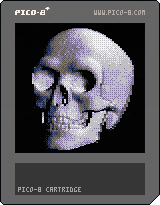
Inspired by old-school demo-scene effects, here is a new and improved grayscale bump map render, which takes 8 bit height map input and generates real-time shading effects.
Please see GitHub for Python image conversion script and sample files. (https://github.com/electricgryphon/pico-9-height-map-converter)
I found the skull height map in the following forum:
http://www.cnczone.com/forums/artcam-pro/156994-last-supper-bas-relief-trade.html
--Electric Gryphon
5 comments






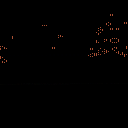
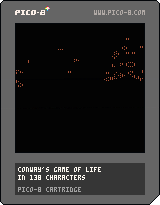
Ok with a bunch of help from LRP I have an entry that works in 138 characters! I'm so happy I managed this. I didn't think I'd actually be able to compress it this small. It was a lot of fun to do.
code:
k=2^13::s::for a=0,k do n=0 for x=0,8 do n+=peek(k*3+a+x/3+x%3*64-65)end poke(a,n==12 and 4 or n==16 and peek(a))end memcpy(k*3,0,k)goto s |
Original post:
Was trying to make Conway's Game of Life into a #tweetjam entry but wasn't able to get it below 175 characters. It reads the screen to do the simulation so while it will always display the same simulation from the BBS you can do whatever input data you want if you download the cart by having whatever you like on screen when you hit run.
6 comments


This is a simple demo of storing movement in speed and angle values instead of speed-x and speed-y. It shows a ball bouncing around inside a box.
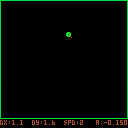
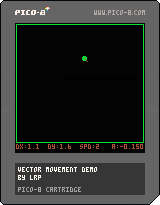
Controls:
up/down: change movement speed
left/right: change movement angle
x: pause movement
z: randomize the movement angle
Introduction to pico-8 angles:
right: 0
up: 0.25
left: 0.5
down: 0.75
The speed of the ball is stored as ball.speed and the angle is stored as ball.angle. When the ball moves, the program uses sin() and cos(), along with the speed and angle, to calculate how far to move the ball in each direction (x/y movement).
dx=ball.speed*cos(ball.angle) dy=ball.speed*sin(ball.angle) |
The advantage of storing the speed and angle speed-x and speed-y is that they are easier to change directly than manipulating x-speed and y-speed. For example, when the ball bounces off a wall, you can just change the angle and know that the speed will stay the same.
This demo calculates speed-x and speed-y every frame, which isn't really necessary. In a real program, you would probably want to store all four values: speed, angle, speed-x and speed-y, and only recalculate speed-x and speed-y when you change the speed or angle.
In the bounce_ball() function, the angle you provide is the angle of reflection. For example, a vertical line has an angle of 0.25 (it goes straight up) and a horizontal line has an angle of 0.5 (it goes straight left). You can tweak these angles if you want the ball to bounce off at a different angle.
0 comments

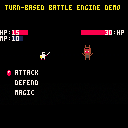
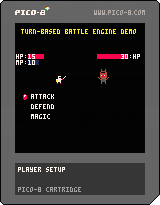
I put together an engine for turn-based battling. I plan to use this for a boss gauntlet game I would like to do in the future or some other project. For the time being, I focused on laying out the foundations and would like to showcase the engine I put together, and maybe some of you would like to incorporate it into your own game. The demo does not contain any audio.
Features
-The general setup with numerous comments on the functions and commands (from a beginner programmer)
-Defense and magic system
-1 boss to fight with a Pseudo AI setup.
Controls
Up and Down Arrow Keys: Move the menu cursor
Left and Right Arrow Keys: Move the magic menu cursor
Z: Confirm action.
[u]Notes
0 comments

Hi all!
I am putting some time in improving my code and make my tiny game smooth and decently playable.
The result I obtained is really far from this (bugs everywhere, the game is slow and boring, it accelerates and slows down without any apparent reason).
Clearly there is a lot to do and a long path to walk but I'd love if you guys can share any suggestion like changes I need to implement, maths / physics / trigonometry I need to study.
I am sorry if this question is very broad but I'd be incredibly happy to get even the tiniest hint.
This is my current code:
https://github.com/ltpitt/lua-pico-8-pong
A version of the game can be found online:
http://www.davidenastri.it/pong
Thanks for your time and patience :)
7 comments




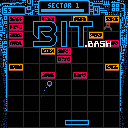
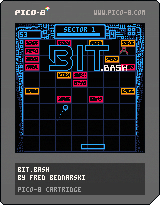
I am finally releasing my (yet unfinished) first game to the wild. It is a breakout clone with a bit of 80s computer UI aesthetic. You can find out more about it, and my learning-to-code journey at my blog: level0gamedev
The game is currently playable only as an endless score attack.
It seems that I have run into (among other things) a serious case of feature creep and it has really stopped me from finishing it. I am releasing this WIP, because I would love for someone to play this thing. Just knowing that someone played it would give me a much needed morale boost. Feeback is very welcome and encouraged! Feel free to ask any questions, highlight any faults or even check the code (it is a huge mess, but this is really my first coding outside of some QBASIC 15 years ago).
Thanks :)
[b]Changelog:
17 comments




I noticed on ps4 that the carts page loads but when you click a cart it does not load up?
Could the carts support the ps4 browser? would be rather awesome to try and play pico-8 carts on the PS4...?
2 comments




I'm having so much fun with Pico-8...I feel just like I did when I was 13 getting into QBasic for the first time in 1996. I used to go with my dad to the university with a floppy disc so I could download other people's QBasic programs, which were often "tiny games" by today's standards.
I love the feeling of being inside this cozy little world, that's all about playing games, reading code and writing code. I didn't think I'd ever be in such a world ever again.
I'm actually part of a world that's almost like this one. The NES homebrew community. Folks actually making real NES games in 6502 assembly (and also C at times). It's not quite the same though as the QBasic world felt, but I love it for many other reasons...
I live for making retro games, thanks to the creator for making this wonderful software. Hopefully I'll have some fun tiny games to share with the community at some point.
3 comments





I am losing my mind over this very simple thing. These don't work:
next(table)==nil
table=={}
table==0
table==nil
This should be so simple but it's not working!! :(
7 comments



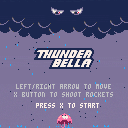
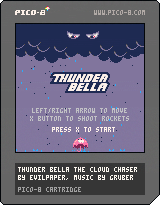
Bella is trapped in a vicious storm. Can you beat the evil thundercloud and save Bella?
Use fireworks and power-ups to win the battle.
New in this version:
Added a clock in the top of the screen so you can time your rounds. Updated the in-game title to match the cover art.
Thanks for all feedback, enjoy!
22 comments







Hi! I'm toying around with Pico 8 for fun and relaxation on the side, where my primary pursuit is to develop games for the Nintendo Entertainment System in 6502 assembly.
It's fairly straightforward to implement coroutines in 6502 assembly and use them to represent state machines for entities (actors, etc.).
I was curious if it's common to use coroutines in Lua on Pico-8 for this purpose. I tried searching for "cocreate" in a couple of the featured games but no results came up.
3 comments





Hello community!
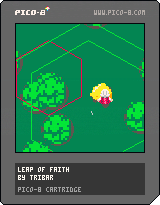
I am looking for music track and sfx (since the ones in place sucks) for my project Leap of Faith. The music track shouldn't be long as game sessions are like several seconds and would increase as game progresses but not that much. Also another track could be for endless title screen.
If someone has a music track or willing to compose I'd be glad to hear!
 0 comments



This is the juiced up version of the game we are going to build today, Mon 3rd, April, 2017, in a workshop I'm teaching at.
And here is the intro cartridge:
 1 comment

