








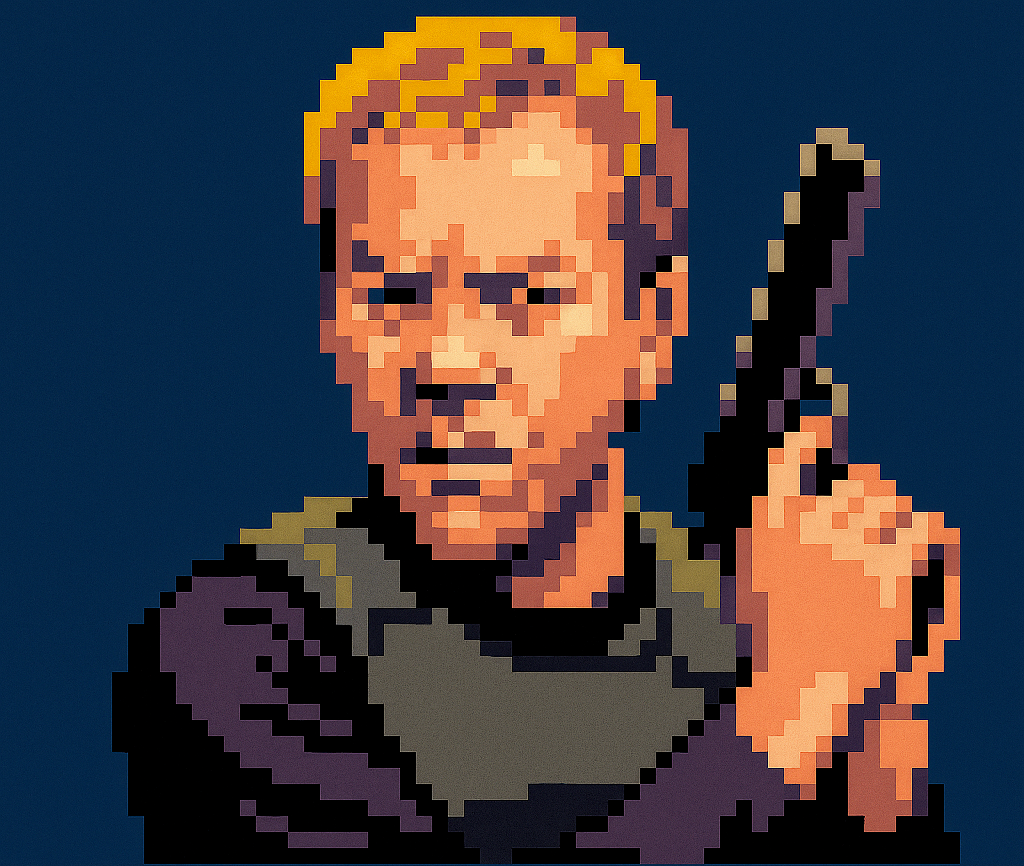
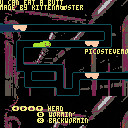
A short game inspired by the Stephen King short story Trucks, made during November for PiCoSteveMo 3.
Credits
- pelogen_tri_129 function by @shiftalow
https://www.lexaloffle.com/bbs/?pid=75530#p - dist_trig function by @pancelor
https://www.lexaloffle.com/bbs/?pid=119363#p - clouds by Aubrianne
- everything else by me
Controls
- [D-pad] move cursor
- [X] change tool
- [O] use tool
Optional mouse controls
If your PICO-8 has a devkit mouse attached, you can open the pause menu and set the "mouse/esdf" option to "on", enabling the following controls:


 5 comments





just noticed an apparent typo in the output of help fillp
there's a part that says this:
bit 0xb.1 indicates transparency. |
but it seems like it's supposed to say this:
bit 0b0.1 indicates transparency. |
0 comments
a cover of the track "UFO 50" from the rad album "UFO 50" by Eirik Suhrke which is the soundtrack for the game UFO 50
4 comments






I just found a weird bug where pushing play in the waveform editor seems to corrupt the first note of sfx 63
Steps to reproduce
- click the "waveform" button in any sfx 0-7 and push spacebar to play
- view sfx 63 and see that the first note has now changed to a C2 using the waveform instrument that you were just editing
using version 0.2.6b
4 comments







This software product was made for https://itch.io/jam/picostevemo and is based on the 2001 science fiction horror novel Dreamcatcher by American writer Stephen King.
5 comments





I think table serialization is a pretty well-known token-saving technique but I hadn't seen anyone post one like this that just operates via peek and poke rather than using strings, so I thought I'd share my table serializer and deserializer here (originally written for PIZZA PANDA) in case this is useful to anyone.
The serializer writes binary data directly to memory so you can use the output however you want, e.g. you can use the "storing binary data as strings" technique to store it as a string, but you could also just store it anywhere in the cart's data.
The deserializer (the part you need to include in your final cart) is 158 tokens and it similarly reads bytes directly from memory.
The serialized format is pretty efficient and uses data types which are more specific than Lua itself, in order to save storage space; each one of the following is a separate "type":
- 8-bit integer
2 comments
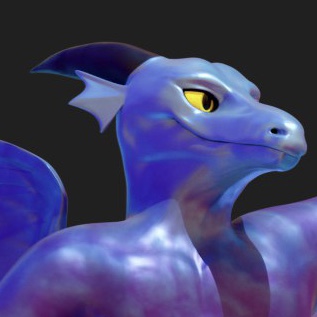


Straight out of the Bamboo Forest!
Meet PIZZA PANDA, a fluffy little fast-driving bear, as he beeps, bounces, and barrels his way through 20+ levels in search of the lost pizza slices. He'll have to zigzag through city streets to beat the clock, delivering the freshly reconstructed pizzas straight into the mouths of hungry citizens.
But that's not all! Puzzling hats, helpless rats, and meddlesome cats also await PIZZA PANDA and his trusty red automobile. It's non-stop action all the way to the top of the winner's podium!
Controls
- Jump: 🅾️
- Honk/Start Level: ❎
- Move Left/Right: ⬅️/➡️
(open the pause menu to restart a level or return to the overworld)
44 comments









I'm pretty sure I remember this working correctly in a previous version but as of version 0.2.5g if you navigate left/right through patterns in the music editor using the -/= keys on the keyboard, if you get to an empty pattern, the keys no longer work and I haven't been able to find any way to regain control of moving through patterns except by using the mouse.
0 comments
as of 0.2.2, all menuitems now have their functions called when left/right are pushed while the menuitem is selected?? It took me an embarrassingly long time to realize this... (probably due largely to a bug where the menu doesn't actually close but the items are still triggered, even if the function does not return true which helped to obscure this behavior)
@zep it seems like this change to menuitem's functionality was intended to be extra functionality and only improve the capabilities of menuitems, but the problem is that the new functionality is always activated, even it's not needed or wanted, so if the user accidentally presses left or right (which is very easy to do with a joystick or with the mobile D-pad UI, and this is how I noticed it!) the menuitem's function gets triggered, and the only way to prevent that (i.e. in order to maintain the old behavior where left/right do not trigger the function) is to use up more tokens in the menuitem's function to check which button was pressed!
1 comment

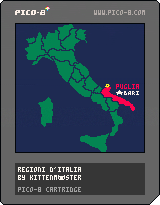
solo un piccolo cart per aiutarmi a imparare
aprire il menu per attivare la modalità "quiz"
bird sprite adapted from @SirTimofFrost's picobirds :>
6 comments





Does anyone know if there is a way to exit early when a print command is running with the \^d p8scii special command that adds delay frames in between each character?
I'm in token crunch mode and realizing this new special command could be extremely handy for easy RPG-style printing delay with zero code in certain situations, but if there was a way to exit early, it would be even more useful!
And if this is not currently possible, consider it a feature request :p
3 comments


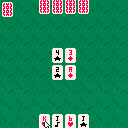

I've been playing a bunch of Cassino lately in real life, so just for fun I thought I'd try making a simple PICO-8 version of it where you play against an AI.
The suits are all just built-in PICO-8 glyphs so note that the stars are spades.
If you've never played Cassino before, it's a really fun two-player card game (it can technically be played with more than 2 players but it doesn't work nearly as well) with an uncommon "fishing" mechanic and I highly recommend trying it with a real human!
TODO:
- multiple rounds with alternating deals until someone reaches 21 points
- SFX
- title screen/better cart label?
1 comment
Feature Request:
a config.txt option to allow PICO-8 to respond to gamepad input even when the window is not in focus
I imagine this option would be disabled by default, but it would come in handy for a workflow which is very common for me, wherein both PICO-8 and an external text editor are open side by side (and sometimes also a terminal window for viewing printh output) and I want to be able to control something in the game with my gamepad, but then also be able to type in a different window using my keyboard, without having to switch windows as frequently. Obviously in this out-of-focus situation PICO-8 would have to ignore keyboard input, but still respond to gamepad input.
love,
kittenm4ster
1 comment