






Hello, long-time listener, first-time caller here. First time making a game, as it goes, I guess. This is me trying to learn by doing, both game design and Pico-8.
This is available on Github, too, just because that's a toolset I use more regularly, but I'll endeavour to update in this thread and the code repo at the same time.
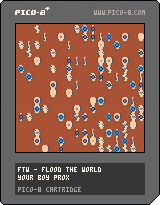
Name: FTW - Flood the World
Concept: You get three seconds to pick somewhere to unleash a storm. You get a score based on how big a flood you make.
Each tile on the map has a randomly-assigned amount of “slope” which determines how much accumulated water is needed to spread to neighbouring tiles. Each tile also has an amount of water within it, which accumulates as the flood spreads.
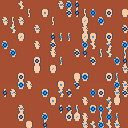
Progress: Procedurally generated map with two bits of data per tile - one for slope, one for collectable water. Map being represented by sprites depicting how much/little hill and water there is per-tile, but at the moment just flat top-bottom hills existing, need to do neighbour recognition to form river-type shapes that join up properly.
Map can be sized dynamically and seeded according to how much impenetrable hill is placed (fully dark tiles) vs spreadable hill (any tile with beige on it). Map is scrollable, currently set at 150x150 because that seems like the biggest it will feasibly go, at least the way I’m storing it right now ;)
Next: Make joined river graphics make sense to the human eye.
Any feedback welcomed, either conceptually, about how I'm misusing Pico-8 or anything else. This is the first time I've really spent more than an hour on anything with Pico-8 so I'm very much learning as I go.


 1 comment


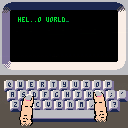
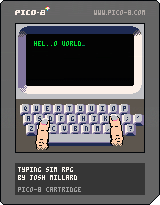
(Ooh, this cart clipboard thing is new since I last posted!)
Typing Sim RPG! Very early work in progress, but I've resolved to start posting works in progress to the BBS more because it's fun to share and I should let folks play with the things I post gifs of on twitter.
CONTROLS:
- arrows to move the fingers
- z to type with left finger
- x to type with right finger
GOAL:
Right now all you can do is type. This is the, uh, open-world part of the game.
WHAT'S THE BIG IDEA THOUGH:
I want to turn this into a proper RPG. You'll start with a character creator where you name your fingers, select skin tone, nail polish, finger size, etc. You'll select starting stats that affect things like finger dexterity, shakiness, precision.
And as you complete typing quests, you'll earn XP you'll be able to boost those stats to improve your ability to translate dpad/button input into accurate typing. You'll maybe find magical equipment (probably mostly rings given the context) that'll help out your typing in various ways. And so on.
BUT DOES IT SUPPORT DVORAK:
Yes, and also Colemak. But for now those are only accessible by going in and tweaking the code a little.
9 comments






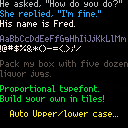
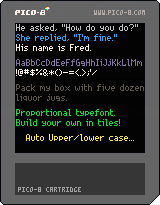
Usage and routines included inside.
I mentioned this method earlier to someone - I guess they never got around to doing it. It's overdue so here it is.
0 comments



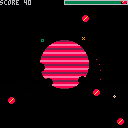
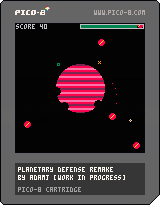
Remake of the classic Atari 800XL game Planetary Defense by Charles Bachand and Tom Hudson with a little but notable modification of the original gameplay: The amount of shots you can fire is limited and you need to recharge by staying near the green orbital base.
Shoot the giant red bombs out of the sky from the orbit. Don't hit your own planet. Don't let the bombs hit the planet either. Once any bomb reaches the core of the planet (coordinates 63:63 on the screen), game ends. 10 points for shooting a bomb.
Arrow keys: Aim
Z: Shoot
X+UP/DN: Alter the orbital speed
11 comments



While there are some definite head-turning elements in PICO that help game writers, occasionally I will come across something - strange.
And this is one of them.
cls()
for i=0,3 do
  for j=0,3 do
    print(j.." "..i)
  end
end
print""
print(i)
print(j)
-- ^ nil ??
|
That's right, if you run this, instead of getting "4" and "4" for the end it gives NIL.
What gives ?? Is FOR (variable) even using a variable ?
3 comments


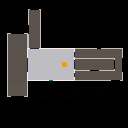
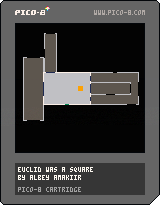
Made for the Sydney NSI Game Jam 11 in Australia.
The theme was Mad World, and the t-shirt was bloody awesome.
I made a non-Euclidean maze.
It's not so much a game as it is cool tech with flimsy gameplay.
I have not worked out my math brain this hard for a long time. So much math debugging. D:
11 comments



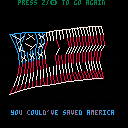
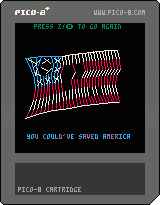
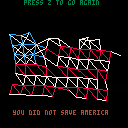
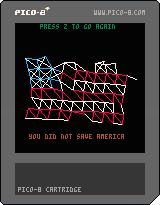
Version 2.0
Made some changes to make this thing a bit cooler:
-
Overhauled the cloth sim so it operates in 3D now. It's projected orthographically ("just uh, ignore the z value for rendering," in this case), so there's no parallax - but even so, allowing points to move on the z-axis produces much more believable motion. I'm leaving the old version up for comparison. Particularly, the mostly-intact flags don't hold themselves upright like a rectangle made of jello anymore.
-
Added basic "quad rendering." It draws two extra pixel-lines to connect pairs of simulation-lines. Makes it seem like the simulation is much higher-density than it actually is - score! (The cloth sim uses 7 rows with 10 particles each). For style, some of the simulation lines are now invisible (like the horizontal lines along unbroken stripe segments, and all the non-star diagonal structure lines)
- Added an extra prize when you win. It doesn't tell you in-game, but you can mash the "cancel" button on the victory screen to stress test it. Be careful not to hit the OK button, since that still acts as the reset button, like usual.
[b]Version 1.0
20 comments






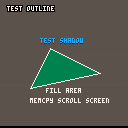
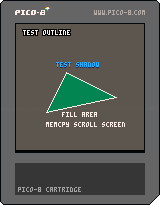
I'm seeing a few similar graphic effects that seem to be of use in games. The most of which is having an outline appear around text and to shadow it.
I also saw someone working on a "FILL" routine but it kept crashing because it was recursive.
Here are truly 5-lines of code with one routine to each. Ah, I didn't say how LONG each single line of code was though, did I ? :)
While I have you on the horn, I was hoping someone could submit source for a few useful routines not just for me but likely others:
1. Draw Hollow Oval & Filled Oval
- Draw Polygon & Filled Polygon (w any # of points, not just 3 or 4)
6 comments


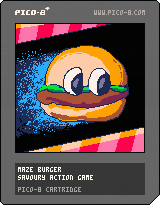
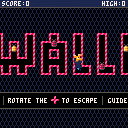
1.03 Updated label image.
Guide the sparks to the flag. Avoid the enemy blobs. Rotate the maze to escape.
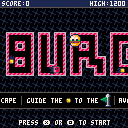
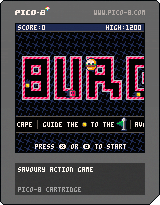
1.02 changes
- Wallflower becomes Maze Burger for whimsy and visual clarity
- Directional indicator when adjacent maze cell can be rotated
- Persistent high score
 6 comments



i figure everyone makes squashy but ive only had pico8 for a few days and i wanted to test uploading something since i made this from my pocket chip
3 comments
UPDATE:
10-22-16 Made code a lot smaller w better coding
10-22-16 Changed random for cycle, makes tighter maze
10-22-16 No hesitation, hold (O?) to build maze
Sometimes programming languages are too complex for their own good.
Take B4GL. It's designed for building 3D games so to even get a simple rectangle or square that is measured by true-pixels on your screen is a pain to achieve without first defining your graphic plane of existence.
Even BlitzMAX must rely on you saving regions of raster information on the order of R G B A where A is alpha, in order to read it back.
Clumsy - inefficient, and then there is PICO.
Read a pixel, write a pixel. What could be easier ? :)
This is a program I've been meaning to try for a-while but didn't want to fight the architect of the other languages that don't handle individual pixels so well.
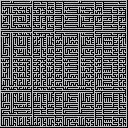
I had it in my mind. Draw a random vertical or horizontal line. Draw another. If it intersects an existing line, HOP over it. Keep repeating until no more lines can be added. Done.
I really didn't know what to expect, and now I can see it is a very definite and DIFFERENT type of maze maker.
Try and solve the maze with your fingers from the top-left-hand corner to the bottom-right-hand corner. It's not as easy as it sounds.
Enjoi !
QUESTION!
10 comments


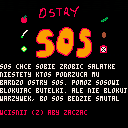
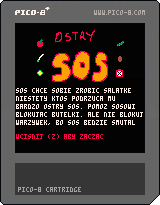
Sos was unable to join us at the GIC/PGA this year, so we held a small jam in his honour. A simple game where you have to help Sos make salad, while preventing hot sauce from getting into the salad.
Controls are arrow keys. Prevent only sauce from falling in, if you'll prevent veggies 3 times, you will lose.
6 comments


So when TRASEVOL_DOG released his Pixel Session Vol. 1, it made me wonder what it would take to make a desktop version of a PICO-8 game.
So I went out of my way to document how I did it with electron!
Comments and feedback welcome!
http://missingsentinelsoftware.com/blog/deploying-pico-8-cartridges-electron
1 comment

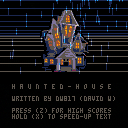
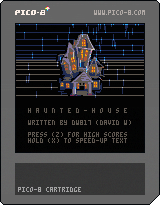
UPDATES:
10-22-16 ... Took out freeze player for standard messages
SIGH This took a lot longer than it needed to. Kept running out of memory all kinds of directions. And - I guess this was a definitely learning experience.
The main thing is, THE GAME IS DONE !
Try it out (preferably with the EXE PICO or Google Chrome as Firefox can stagger).
Instructions ? I don't want to give out too much as curiosity is always rewarded in this game. :)
Use the arrow keys to navigate. Use the lightning to give clues as to where obstacles are. Hit (Z) (O?) to use up a valuable match. You start with 3, you might find more. You have a shield generator at 9.
Your mission, just as you were told, find out what happened to the relatives in Old Man Mildew's manor and report back.
Some things won't activate until you've done the right thing first. While the game is entirely turn-based, you have a relentless clock, and once it hits midnight, you'll have to deal with Mildew's angry and impatient spirit.
High Score and names are kept and recorded for 10-entries, even after rebooting.
As with all games you've played, PLEASE let me know if you find any bugs or outright crashes. I think it's pretty solid at this point. The code ? A little over 5,000 symbols of a possible 8192.
The characters, not so bad, 27870 out of 65536.
But really PICO is a bit of a cheat since right around this area, despite having space, it won't save to PNG with much more code. I would think since it's a fantasy system that only when you EXCEED your symbols or characters maximum space - THEN it can start complaining about not being able to save as a PNG.
Now, is the game too easy, too hard ? Is the clock too slow, too fast ? Let me know what you think !
Last minute changes:
- Sped up clock
- Integered clock (for scoring)
- Removed debug score line
15 comments




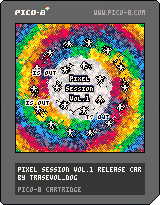
Hi there!!
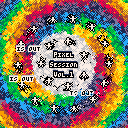
I just released Pixel Session Vol.1!
If you follow me on Twitter and go on Twitter at all, you probably heard of it but otherwise...
Pixel Session Vol.1 is a collection of 5 extra-polished eye-candy arcadey jam-style games, exploring experimental and minimalist gameplay and graphics!
They're also 5 Pico-8 games and I am selling them!
I think this is the first time someone attempts to sell Pico-8 games and I can assure you this is pretty scary for me too. But the way I see it, Pico-8 is a game engine like any othe... wait no, Pico-8 is a game engine LIKE NO OTHER and I think it really deserves to have premium products. I also hope this will encourage people to make Pico-8 games of higher quality and also put them for sale.
24 comments






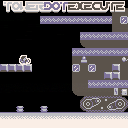
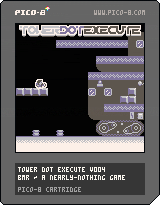
I'll keep this short, since I'm talking more about a potential game than an actual one at this point in my learning, but my end-goal here is to create a platformer that will run in the same vein as some of my favorite games of all time—Bionic Commando. Bionic Commando, but with hulking, mobile, desert tank towers. In my head, I'm thinking these Towers each be a level, as well as it's own boss. So maybe I'm also drawing some inspiration from "Shadow of the Colossus".
That said, the ability to jump is in this very very very early prototype version as a placeholder. It's much less complicated than figuring out how to program a grappling-hook, and I wanted to test my very basic, first attempt at 2d physics and basic ground-collision detection.
I work on this a bit every day, and so far I've made at least notable progress each time. It might take entirely too long, but I am bound and determined to finish at least this one game.
And—please, please, please—if you have any suggestions, tips, tricks, or advice of any sort, I would LOVE to hear from you.
~To-Do~
• Learn a whole bunch of things. Like, virtually everything.
~More Optimistic To-Do~
• Figure out how to get the outline beneath hero's feet to go behind ground sprites when she's standing.
• Increase map size by 3x/4x and learn to program the "camera" to follow the hero around.
• Replace simulated screen-wrapping with hard edges so the hero can't walk off the map.
• Add/animate grapple hook, map to button (not trying to add the actual mechanic yet—baby steps).
• Add/animate a sliding kick/dodge, map to button (once again, just animating—mechanics later).
~New in v003~
• Improved the ground collision detection so that the hero doesn't pop-up through the floor
• Re-colored everything to fit a Gameboy-esque, 4-color palette. For coolness.
• Added some useless sprites to decorate the tank-thing up a little bit.
• Added a sliding-stop effect when direction buttons are released
• Added jumping and falling animations
5 comments

