I use my tablet with a bluetooth keyboard pretty frequently, and would like to have at least one serious (pico8 is a serious html5 maker) making tool. is it possible? its arm, like raspberry pi, so it shouldn't be a problem.


 5 comments



Is there a FAQ/HOWTO that describes the proper way to embed a PICO8 game on a web page .. I guess I can just read the sources for the pages already and reference the loader script, but in case there are gotchas/requirements for PICO8 being run that way I thought I'd better ask.
0 comments

Please help me understand how screens are drawn in Pico-8. When I first started playing, I thought sprites would be like player missile graphics on my Atari, but it doesn't look like that's the case. It looks like I clear/redraw everything on the screen with the _draw() function. Is that correct?
2 comments



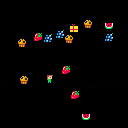
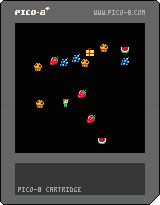
I just started playing around with Pico-8 and while I've been programming for a very long time, I've never done so at such a low level so I'm finding P8 a great challenge that is wonderful escape from my daily style. That being said, I'm looking for code review-style feedback on my first little learning game.
I'm making a simple game for my preschooler daughter so it's not complicate but it's requiring me to cover all the basics for making any game - collisions, maps, sprites, movement, etc. This first pass focuses on movement and object/sprite collision. I watched the "popular" light cycle tutorial as well as read through the Fanzines and took all that cobble something together. So thanks to all of those people! It's be a treat learning something new.
Right now the game is just moving the character around and collecting food items. Run into a present and food pops out. Run into the food and they disappear (collected). That's it.
Again, I'm just looking for feedback on how it's written, probably mostly around the architecture and places where I'm wasting space. The game is working as I expected, so there are no bugs, per se...just looking for efficiencies.
I am planning on adding more graphics and stats that keep track of what's been collected. There will be other screens but that's the next lesson.
I appreciate any feedback, thanks!
pickups={}
player={}
box={}

-- ///////////////////////

function _init()
	cls()
	createplayer()
	createbox()
end

function _update()
	foreach(pickups,function(o)
		if (o.wild and collide(o,player)) then o.wild=false end
	end)

	if (collide(box,player) and box.closed) then
		box.closed=false
		for x=1,4 do add(pickups, createpickup()) end
		createbox()
	end

	player.update()

	if (btnp(5)) then createbox() end
end

function _draw()
	cls()
    foreach(pickups, function(o) o.draw()  end)

    player.draw()
    box.draw()
end

-- ///////////////////////

function createbox()
    box.closed=true
    box.x=flr(rnd(110)+10)
    box.y=flr(rnd(110)+10)
    box.hitbox={x=0, y=0, w=8, h=8}

    box.draw = function()
       if(box.closed) then spr(1,box.x,box.y) end
    end
end

function createplayer()
    player.x=60
    player.y=60
    player.spr={3,2}
    player.cel=2
	player.dir=1
    player.hitbox={x=1, y=0, w=6, h=8}

    player.update=function()
        -- movement controls
		if (btn(0)) then move(player,4) end
		if (btn(1)) then move(player,2) end
		if (btn(2)) then move(player,1) end
		if (btn(3)) then move(player,3) end
    end

    player.draw=function()

        spr(player.spr[player.cel],player.x,player.y)
    end
end

function move(obj, dir)

obj.dir = dir
	if (obj.dir == 1) then obj.y = obj.y-1 end
	if (obj.dir == 2) then
		obj.x = obj.x+1
		player.flip = false
	end
	if (obj.dir == 3) then obj.y = obj.y+1 end
	if (obj.dir == 4) then
		obj.x = obj.x-1
		player.flip = true
	end

	if (obj.x <= 1) then obj.x = 1 end
	if (obj.y <= 3) then obj.y = 3 end
	if (obj.y >= (125-8)) then obj.y = (125-8) end
	if (obj.x >= (125-6)) then obj.x = (125-6) end

	--p.spr = p.spr + 1
	--if (p.spr > 2) then p.spr = 1 end
	if player.cel==1 then player.cel=2 else player.cel=1 end

end

createpickup=function()
    local obj={}
    obj.x=flr(rnd(110)+10)
    obj.y=flr(rnd(110)+10)
    obj.spr=flr(rnd(5)) + 64
    obj.hitbox={x=0, y=0, w=8, h=8}
    obj.wild=true

    obj.draw=function()
        if (obj.wild) then spr(obj.spr, obj.x, obj.y) end
    end

    return obj
end

function collide(obj, other)
    if
        other.x+other.hitbox.x+other.hitbox.w > obj.x+obj.hitbox.x and
        other.y+other.hitbox.y+other.hitbox.h > obj.y+obj.hitbox.y and
        other.x+other.hitbox.x < obj.x+obj.hitbox.x+obj.hitbox.w and
        other.y+other.hitbox.y < obj.y+obj.hitbox.y+obj.hitbox.h
    then
        return true
    end
end
|
4 comments


Okay, I know this sounds ridiculous, but hear me out for a second:
The "POCKULUS CHIP" is just a piece of plastic you attach to the front of the PocketC.H.I.P case to split the screen in half, making one eye look at the left half of the screen and the other eye look at the right half. Unlike the Oculus Rift, the Pockulus does not require any fisheye rendering, nor include any headtracking. It has more in common with a View-Master than modern VR.
That means, all it would take for the Pico-8 to have "VR support" with the Pockulus, is to change Pico-8's screen space usage to draw twice, split far enough apart that it uses the 420x272 pixel display evenly, and then either call the _draw() function twice per frame with an argument saying whether the left or right screen is rendering or use one of the already existing secret "stretched 1/2 resolution" screen modes and actually use the entire 128x128 Pico-8 screen to render two stretched images for the left eye and right eye. You can use clip() to constrain rendering to one side or the other. Let the cartridge developer figure out how they want to make depth perception.
7 comments




I'm working up the basics for a small tile puzzle game where players navigate through a maze filling the path behind them so that they can only move on each tile once. so a trail that will then have some collision so it can't be crossed
I'm having trouble working out how to leave a trail of sprites. I have a grid set up, and a player sprite to move as follows:
function _init() x = 0 y = 64 end function _update() if (btnp(0)) then x=x-8 end if (btnp(1)) then x=x+8 end if (btnp(2)) then y=y-8 end if (btnp(3)) then y=y+8 end end function _draw() rectfill(0,0,127,127,7) spr(1,x,y) end |
I've tried having something in draw but this ended with the designated sprite following the player around and I tried adding something in the update function with the keystrokes but this b0rked it.
It seems to be something beyond what I kno so even if someone can point me in the right direction of something to read up on or code to review that would be much appreciated.
1 comment


Is anyone making carts that use 4x4 sprites? How do you manage clipping and printing them?
4 comments


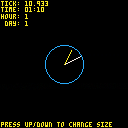
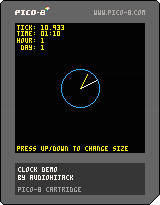
Just an example of an analog clock you are welcome to use in any project.
Will work in a realtime fashion, like the demo. Or could be passed a static hour/minute and work as a nice background prop in a game. Obviously you could style things up a bit better.
The basic code (see cart for full detail, though):
clock_size=10 --radius of clock clock_color=12 --blue hr_hand_color=10 --yellow min_hand_color=7 --white -- draw_clock(minute, hour, origin x, origin y, radius) -- ex: `draw_clock(45,3,50,50,10)` would draw a clock at 50,50 with a -- radius of 10 pixels and the hands set accordingly function draw_clock(m,h,x,y,r) -- min hand 1 px smaller than the clock radius local mh_len=(r-1)*1.0 -- hr hand 2 px smaller than the clock radius local hh_len=(r-3)*1.0 m_x,m_y=clock_hand_position(m,x,y,mh_len) -- multiply the hour value by 5 for hand position h_x,h_y=clock_hand_position(h*5,x,y,hh_len) -- draw the outline of the clock circ(x,y,r,clock_color) -- draw the minute hand line(x,y,m_x,m_y,min_hand_color) -- draw the hour hand line(x,y,h_x,h_y,hr_hand_color) end -- clock_hand_position(tick, origin x, origin y, multiplier for hand length) function clock_hand_position(t,o_x,o_y,m) -- rusty trig ahead. beware. t-=15 t=t%60 -- handle 60 tick factors t=60-t -- determine x,y from cos/sin local x=cos(t/60.0) local y=sin(t/60.0) -- multiply the x & y by `m` x*=m y*=m -- offset from originating coords x+=o_x y+=o_y return x,y end |
0 comments

Is anyone else getting crashes when using Pico 8 in Windows? I'm using pico 1.6 in Windows 7, never had a problem before 1.6, but now I'm getting seemingly random crashes.
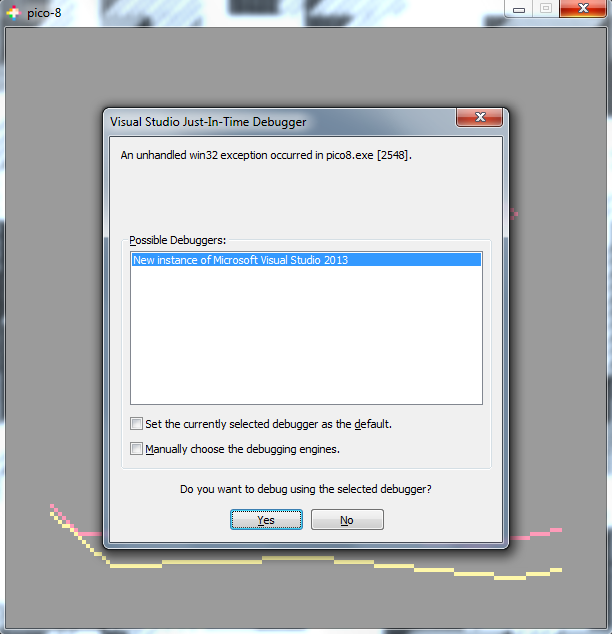
I don't think it's my code causing it, though I can't be entirely sure. But my code isn't really any different than past projects of mine, so if it is being caused by the code I have no idea how.
1 comment



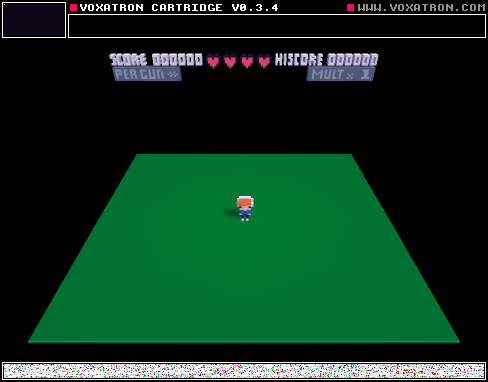
May the fourth be with you! My friend and I would like to share our nerdy addiction with starwars!
Feel free to edit it, and like... KYLO REN, WHY?
0 comments
I've been doing some SPLORE'ing and set up a list of Favorites - now I'd sort of like to have a look at the cartridge files .. but try as I might I can't work out where PICO8 is storing my Favourited carts .. its not in ~/Library/Application Support, like I thought it might be .. is there somewhere else to look?
4 comments

Hi,
I can't seem to get SPD to decrement with a right-click using my MacbookPro trackpad - call me stupid, but isn't CTRL-Click supposed to simulate a right-click? This is borked, it seems .. or I'm stupid. Can someone enlighten me?
4 comments

Copying and pasting code in the editor results in the pasted code having a space added at the end of each line. Also, spaces at the end of lines count for a token. These two bugs together make it frustrating to reuse code.
2 comments


Hi there,
In my up-to-date standalone PICO-8, my score display works great; however, in the web player in the BBS, the score displays as something not-rounded and weird like 1000.232823. Is there a difference in how integers are handled?
19 comments

Hi!
I'm looking very much forward to getting my PocketCHIP hardware, with PICO8 built-in .. and one of the things I'll be doing with the PocketCHIP is using it as the basis of a MIDI processor system.
So I was wondering - if we get PICO8 on PocketCHIP, would it be possible to request a feature for a new version of PICO8 in the future: MIDI I/O support?
This would be awesome! :)
5 comments


 [
[ ](http://www.robysoft.net/kidorion_box_600.png)
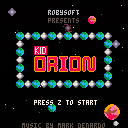
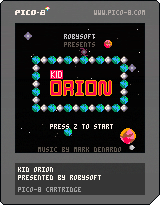
Kid Orion is a short, twitchy, 5-level space exploration game inspired by Lunar Lander and Solar Jetman. Find the landing pad to advance levels, but don't run out of fuel or health! Beware the Space Ram! Features music by Mark DeNardo. Excellent faux box art by Jacob Smiley.
Controls:
Left and Right Arrows: Tilt Ship
Z: Fire Cannon (once obtained)
Comments welcome! Post your score if you win! I make other games and weird stuff at ROBYSOFT
3 comments

.jpg)


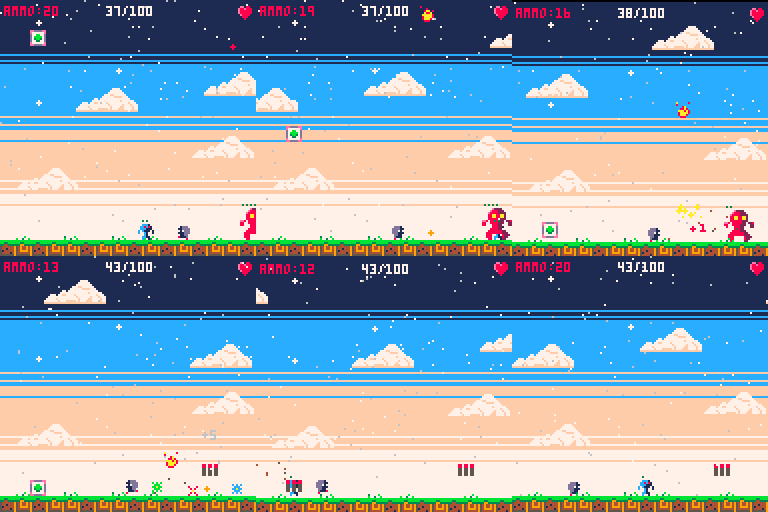
How To Play
- X to Shoot Stuff
- Arrow Keys to move and jump
- Fire at health crates to turn them into ammo
Description
The pollen wars are in full effect and it's up to you to destroy the robots that seek to eradicate all pollen from your planet.
Shoot Stuff is a small arcade game that can be completed in a single sitting. This was my first Pico-8 game and I had a blast making it. Everything about this game was inspired by the Pico community and all the awesome things you guys are making.
Acknowledgements:
9 comments






https://atom.io/packages/language-pico8
I based this extremely heavily on someone's Lua highlighter, but there's a few nifty features. It'll only highlight lua code in the lua section, and it displays stuff in the gfx section as pictures.
0 comments


If you're looking for a complete portable PICO-8 solution, good news! PICO-8 is going to ship pre-installed on Next Thing Co.'s upcoming PocketC.H.I.P. -- a complete portable mini-computer with built-in storage, wifi, keyboard, battery, touchscreen and everything else PICO-8 needs! The last few months, I've been working closely with the team at Next Thing Co. to create "PICO-8 C" -- a fully functioning and compatible edition designed to integrate nicely with NTC's hardware and software. It will be available to Kickstarter backers, or you can also pre-order one for just $49 bucks.
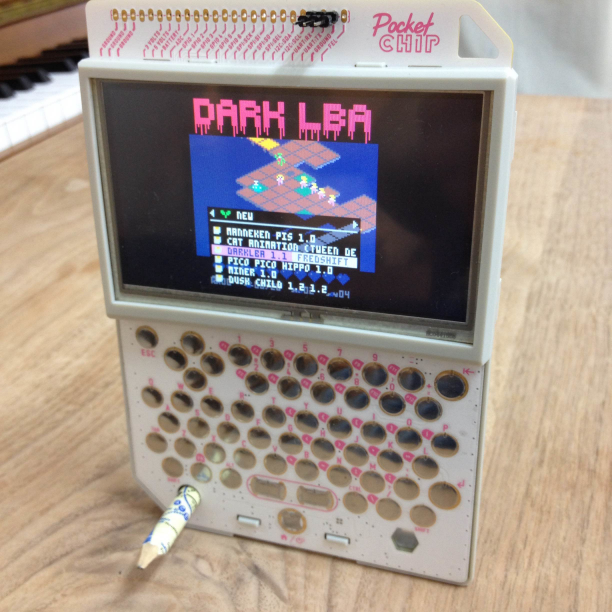
You can read more about the PocketC.H.I.P. over at getchip.com
42 comments