I'm on Mac OS X and right clicking to decrease speed (SPD) and LOOP does not work and hasn't worked for some versions now.


 3 comments




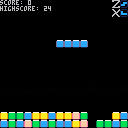
An entry into Ludum Dare 35, made in about 7 hours.
The theme was Shapeshift - Tetrift between the different Tetris shapes to clear both lines with just one piece! Use Z and X to change piece and Left and Right to move. Up is rotation and Down drops the piece faster.
4 comments




Hi,
We are organising a coding party in Nantes (France). You are welcome to join us in the workshops and for the game jam. All of this made with PICO-8.
Please, have a look on the flyers : flyer (english), flyer (french).
=> Website (Registration closed)
=> Follow us on facebook and/or twitter
jihem (@wdwave)
12 comments


I would like to use black in my player sprites, how can I remap the color so that, for instance, color 12 is transparent in that sprite instead of black?
Thanks.
3 comments



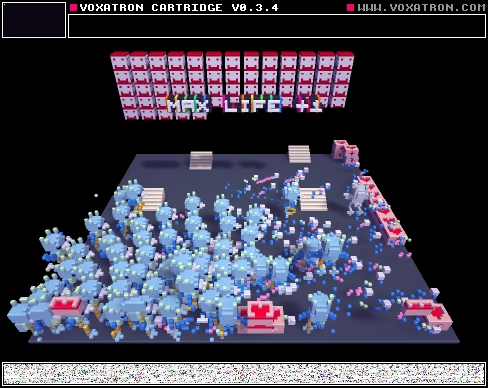


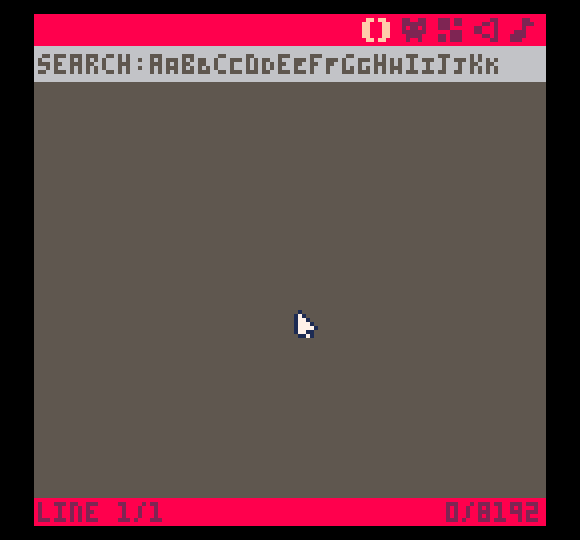
So if you have caps lock on or hold shift and start typing in the search bar it uses a 3x4 font! I'm guessing zep tried out other font sizes or tried having 3x5 for uppercase and 3x4 for lowercase or something, and some weird loophole means it accidentally uses the small font for uppercase characters but only in the search bar.
 25 comments


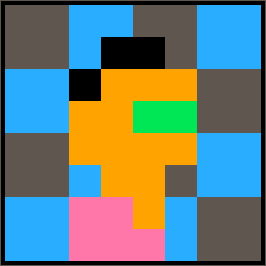
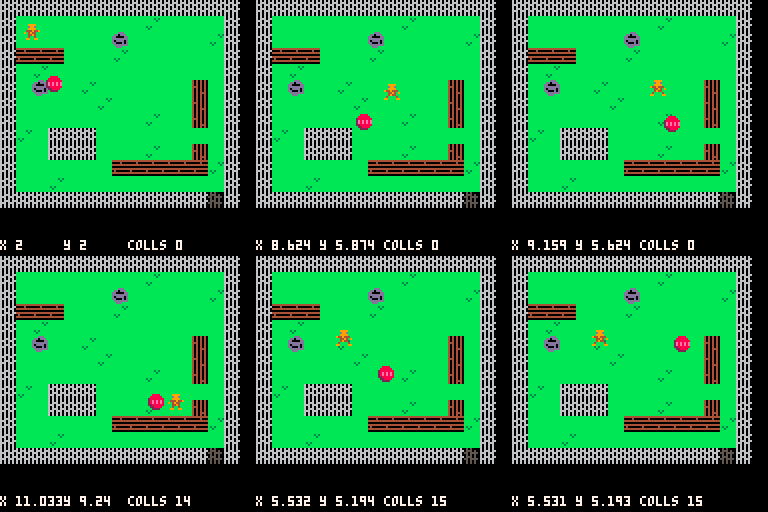
so i started to have a look at carts i could adapt for my own purpose and i've taken zep's collide demo as the basis of my new game: apescape.
here's the story behind the game:
you are an alien (betsigutgrrl) from the planet futon who has come to earth to study humans. you've taken the form of an orangutan, and inadvertently got yourself caught and are now trapped in a zoo.
meanwhile another race of aliens from planet sofa have started to invade earth. can you escape the zoo whilst avoiding the sofarians?
the game is mostly a reskin of the demo, but i've started to keep track collisions between betsigutgrrl and sofarians. this will eventually form the health bar.
power ups will be in the form of fruit and random food left behind in your habitat,
 0 comments
after a few false starts, i've decided to resume game making and allocate my friday commute as my day to do this.
since using pico-8 i've learnt the following:
- writing stuff from scratch is hard
- making graphics from scratch is not so hard
- i care more about game design rather than the coding
so with this in mind, i'm going to use other people's code rather than get bog down by how path finding, collision and ai work.
here's to getting back on the wagon. let's hope i don't die of dysentery.
0 comments


Have you ever dreamed of a pizza-lover-only society? Now you can make it happen!
A tiny god-game simulating modern society.
Not actually a game, a toy rather. The only goals you have are the ones you set yourself!!
CONTROLS:
[i]On BOARD mode:
arrow keys alone: select a different micro-society member
Z: inspect selected micro-society member, learn about him/her and enter MOVE mode.
X + left or right: control time.
X + down: clear logs.
X + Z: display stats of your micro-society.
X + up: ???
[b]On other modes:
0 comments

EDIT: Changed name for Splore, to eliminate special characters in the title
Hey, folks. First post, first video game actually completed!
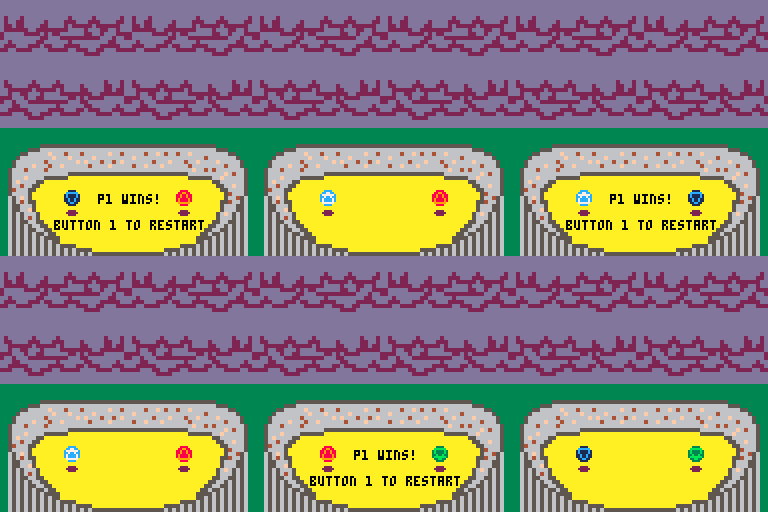
Discovered PICO-8 while looking for sprite animation software, if I remember correctly, and it's been a blast ever since.
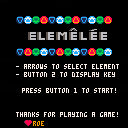
Elemêlée was a simple idea stemming from Rock, Paper, Scissors that I figured I could pull together, and I actually pulled it off! 2-player gameplay only, so bring a friend along for the battle for elemental mastery!
Arrows select the element you wish to use, button 1 to restart the battle, button 2 to bring up the key so you know which direction aligns with which element.
Even though this is pretty much done, as far as major work is concerned, I would appreciate feedback that anyone has!
<3,
Roe
0 comments
Hello,
I have a Pi 2 and I was wondering if there is any way to make it automatically boot pico8 whenever I start it, as I am attempting to make it into a handheld console a la gameboy. Thank you for any help you can give.
1 comment
I wonder - did anyone successfully decode the storage order within the sfx section of a cartridge? I managed to do this with the music section, but the values under sfx seem to behave very strange there, I can't find a practical pattern how the bits are distributed there.
I need to write binary data from within my python script and now I exceeded 0x3200, so this is a real show stopper for me at the moment, any help is appreciated!
Yet I know:
- each line stores 68 bytes of data
- each byte is distribute with some of its bits to several locations in this line. Filling all bytes with 255 results in a sequence of 3f77f
- there is a special "header" to each line, consisting of five bytes, which are the last ones in memory and which are not distributed otherwise
What is yet missing:
- The distribution pattern of the "regular" bytes
7 comments


So apparently the raspberry pi build of PICO-8 works on the C.H.I.P.!
https://youtu.be/eT3q8U1zQWE?t=2m30s
3 comments



Game based on the Ludum Dare game I made of the same name. It's a very simple 2 player game based on Samurai Kirby and Rock Paper Scisors.
0.2 version: Basic input and flow. No Rock Paper Scisors yet.

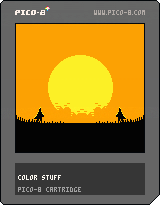
CONTROLS:
Player one: Z, C or N
Player two: Left Shift, Tab or W
link to the original game: http://www.kongregate.com/games/thesaint11/katana-senpou)
0 comments
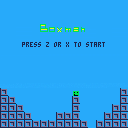
I ported a game originally for the TI-84+ CSE calculator to PICO-8!
Try to stay alive for as long as possible and climb high as crates fall from the sky.
Left - right and z - x move your character.
Original game
Credit goes to Botboy3000
7 comments
.gif)
Hello,
I have been trying to recreate Super Mario Bros 3 in PICO-8, and I have run into a bit of an issue. It would appear that solid-colored tiles don't register in the level editor. I have a fully blue (Color #12) tile in position 000 and whenever I attempt to place it in the level editor, it acts as if it is black. What should I do?
Thanks.
2 comments

(There have been other rants on this topic, but most of the discussion seems to predate the move to token counting.)
So I'm brushing up against the compressed codesize limit with a cart that's barely halfway towards the token limit. It sounds like this is unusual, and from what I can tell it's because I'm commenting the code fairly thoroughly.
And I have to wonder, what is the intent behind the compressed size limit? What is it still meant to accomplish that the token limit doesn't already?
The token count is a rough representation of binary or bytecode size, which was an authentic historical constraint for many systems. It's measurable from within the editor: a coder can see at a glance how many tokens they have left and how they are affecting that number as they type. While it's approximate, it's directly correlated to code complexity, and this makes it fairly intuitive to reason about. The steps for reducing token count are also intuitive: simplify code, improve code sharing, generate data rather than hardcoding it, do more with less.
The token limit defines a scope for pico-8 cartridges; it encourages creative solutions and algorithmic content generation, and it plays off the other cart limits by discouraging tactics like offloading data into code.
Compressed code size, on the other hand, is a representation only of [i]how much entropy your source code exhibits
18 comments







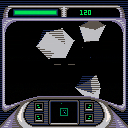
Old version:
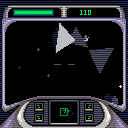
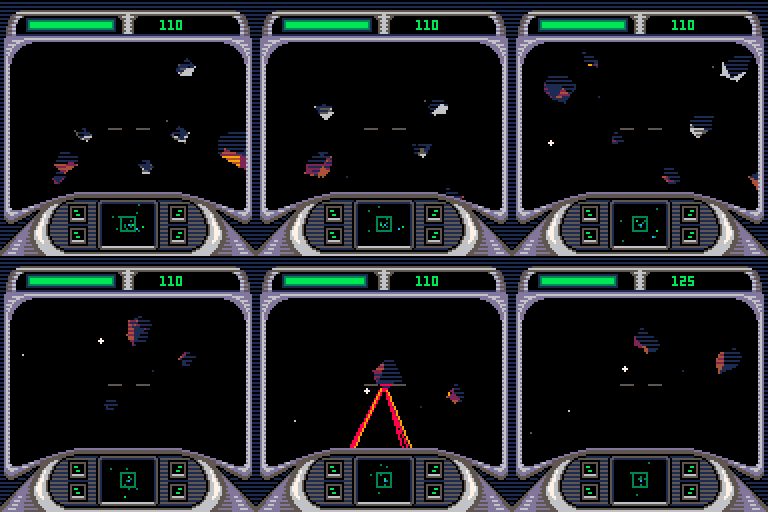
Clean the skies of sector Q97-C with your trusty mining laser.
Keep an eye out for debris, not to mention Turrets and Tormentors.
Controls:
Arrow keys control roll and yaw.
X-key accelerates.
Z-key fires laser.
Tips:
Full 3D navigation can be tricky, so keep an eye on your radar at the bottom.
It can be easier to sweep the laser up over targets than to try to hit them dead on.
Watch out because the laser uses your ship's power, which only refills slowly over time.
Version Notes:
Added music by Robby Duguay
-www.robbyduguay.com
Added sound effects
 22 comments




This was created for LOWREZJAM 2016 in 48 hours, but it's still my first "finished" cartridge I've ever made!
Controls:
Left and Right to move
Z to jump
X to attack
Up to thrust upwards
Down to block
Goal: Bash your opponent off the platform 7 times to win.
2-player only. Enjoy bashing! -Lemmo
2 comments

As Scathe noted over here, there's not a proper/easy-to-use Timers API built into PICO-8. Turns out it's not too hard to build one, though, so I took up the task.
The cartridge which you can play above just counts to 10. I've reproduced all the code here:
13 comments