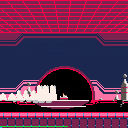
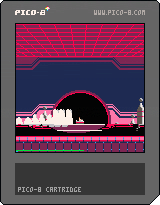
After a few days of making a few sketches around some in-the-books tricks, I got an idea during a dream and decided to make it.


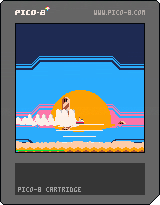
Here's the alternative version. I may use it (or a tweaked version) as a album cover if I will ever do synthwave (or vaporwave, RIP)


 2 comments


This is my lowrezjam 2017 entry. I wanted to recreate the lost woods type of maze in the zelda series. There are things I am happy with, and things I am not. I am going to write up an article about what I gained from doing this jam, even though I didn't submit the actual entry in time. It's a journey not the destination kind of thing when you are learning.
So, make your way through a week as a ghost trying to find your way around a strange place. If you like memorizing long strings of four possible directions then this is for you. You have one maze per day to figure your way out and each day the length increases. Its a Monday through Sunday grind.
It's not much, but enjoy it for a few minutes.
0 comments

Hi,
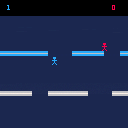
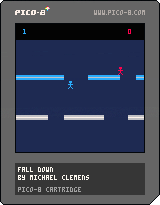
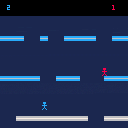
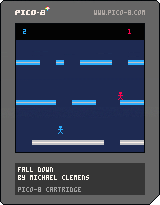
I'm in the progress of cloning the Atari game "Fall Down" (https://atariage.com/software_page.php?SoftwareLabelID=2722) written by Aaron Curtis. It's a simple but very addictive game where the down falling players gain points by passing lines. A player will die when he reaches the top of the screen. It is already playable but the following needs to be implemented:
- AI for single player games
- adding power ups for e.g. creating gaps in lines or becoming faster
- title screen with game mode selection
- end screen
- sound
- acceleration of platfoprms/lines
Player one is controlled via cursor left/right, player two via "s" and "f"
Cheers,
odie
0 comments


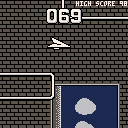
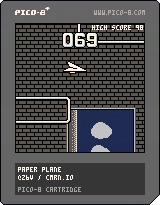
It's a clone of the Paper Plane minigame from WarioWare Inc. on the GBA!
Avoid the walls and try to make it as far down as you can!
6 comments





This is my first thing I've made with Pico-8. Press Z/click to add a circle, and press X to clear.
How it works:
For every time you draw a circle it adds the X and Y of it to a table. Then, in the draw function, all circles in the table are rendered. I thought it was interesting how this rendered the circles so I published it for everyone to see.
1 comment



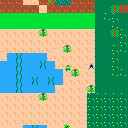
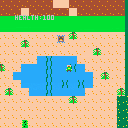
Very early development.
This is mainly a learning experience regarding the making of the game.
:D
0 comments

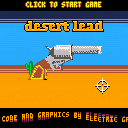
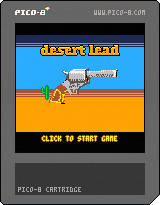
Take aim, fire and score! It's Desert Lead 3D!
Spread the desert with the dented and shattered remains of bottles and cans. It's like recycling, but more destructive.
For use with the Pico Light Gun, Desert Lead 3D is also compatible with the Pico Mouse.
(Pico Light Gun is only available in selected dimensions.)
Click at the bottom of the screen to reload.
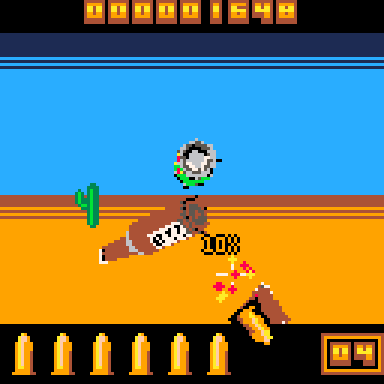
Old version
[hidden]
 19 comments






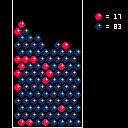
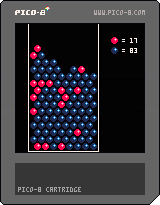
A little demo of Polya's Urn's somewhat counter-intuitive dynamics...
The single rule is: draw a marble at random then put it back and add a second marble of the same colour. Although there is an obvious positive feedback involved ("rich becomes richer"), it turns out that a strongly uneven distribution is not particularly likely!
0 comments



My second contribution to the One Hour Gamejam which, as you guessed, about making a game in 1 hour. Wish I had more time for some levels, those here are a bit random and the game could get a bit more interesting with well thought timings. Not enough time neither for a playable random generation. Well, you ain't do much in 1 hour. But this one has sounds, yay!
http://onehourgamejam.com/
Edit: corrected a bug crashing the game when accessing last level.
7 comments


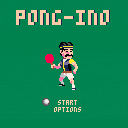
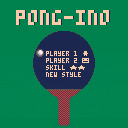
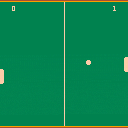
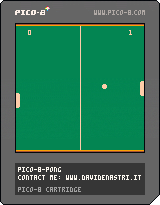
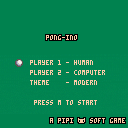


Hi all!
I've completed a very basic implementation of Pong.
I would like to make it nicer adding a classic mode that looks and plays as close to the original as possible.
To do so I'd need, for starters, to increase my paddles speed but when I do so the paddles end out of the screen.
I cannot understand why, this is the code causing the issue, it is very simple:
-- check if pad goes out of the upper part of the screen if button_up and pad.y > game.upper_bound then pad.y-=1 elseif button_up and pad.y <= game.upper_bound then pad.y=game.upper_bound end -- check if paddle goes out of the bottom parte of the screen if button_down and pad.y + pad.h < game.lower_bound then pad.y+=1 elseif button_down and pad.y + pad.h > game.lower_bound then pad.y=game.lower_bound end |
If instead of using 1 I use 2 or more the paddles get out of bounds (or start shaking).
In case you want to check the complete code you can find it here:
https://www.lexaloffle.com/bbs/?tid=29815
2 comments

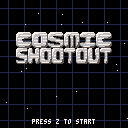
A simple space shooter. Shoot the enemies, and don't get hit.
Arrow keys to move
Enemies sometimes drop their weapons upon death.
X to change weapons once you collect them.
You cannot control when to shoot.
Made for Computer Simulations and Interactive Media Session 2 2017 at Stanford Pre-Collegiate Summer Institutes.
Needs more enemies, weapons, levels, and a final boss, none of which I will get around to implementing anytime soon.
0 comments

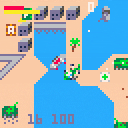
HELLcopter!
Take the Highway to the danger zone in the HELLCopter!
Liberate the island nation of Alruco from its brutal dictator by destroying everything that stands in your way.
3 comments


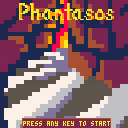
I've been working on this rogelike for about a month now, and I figured I should post it now that I've finally gotten it under the compressed size limit. If anyone's interested I will share the unreduced code, otherwise I'll post that when I'm done with this project.
1 comment

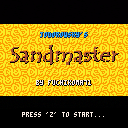
In “Jodorowsky’s Sandmaster”, you play the role of a titular “Sandmaster” on Arrakis, the desert planet in Frank Herbert’s “Dune” universe. I imagined this game many years ago. I first implemented it in TurboPascal in the 1990’s, and have since then created a Java version. The obvious next step was to do it in Pico-8.
I called it “Jodorowsky’s Sandmaster” in tribute to this visionary director’s failed attempt at making a motion picture out of Herbert’s landmark Sci-Fi novel in the 1970’s (an epic story recounted in Frank Pavich’s 2014 documentary “Jodorowsky’s Dune”, which I all-heartedly recommend). I drew inspiration from Jodorowsky’s work in redesigning my game, for instance by making the spice a pulsating, organic, psychedelic blue instead of the more conventional cinnamon brown. The patterns in the sand are also meant to be reminiscent of Chris Foss’s “fishskin” spaceship designs. Of course, none of the great artists who were involved in this ill-fated movie project were involved in my modest game. Should Mr Jodorowsky become aware of it and not wish to be associated with it, I will of course remove his name…
In Frank Herbert’s universe, the Sandmaster is the person in charge of supervising spice mining operations. In the game, you pilot a “carryall”, an airborne vehicle tasked with transporting the spice-mining harvesters to extraction sites. The controls are very simple: the arrow keys set the direction of movement. Hitting the key pointing opposite to the current heading brings the carryall to a halt (hovering). Hitting the “Z” key will do one of 3 things: if above a spice-blow, it will lower a harvester (which immediately start collecting the precious substance), if above an already deployed harvester, it will lift it from the ground. Finally, if above open desert, it will drop a “thumper”.
The difficulty (as everyone familiar with the book will know) is that giant worms roam the desert of Arrakis and search and destroy any object producing a rhythmic noise, such as a thumper or a harvester. In the game, worms perceive vibration up to a distance of 16 sprites and will home into the nearest source. The game consists in finding spice (there’s quite a big patch of desert to explore!), then extracting it while luring worms away with thumpers so as to allow harvesters to complete mining operations. In the game, “wormsign” takes the form of a shifting disruption in the sand pattern. Worms cannot cross rocky areas and have to go around them. If a worm comes within 8 sprites of a harvester, the whole screen starts vibrating as a warning of imminent disaster.
You can deploy as many harvesters and thumpers as you like. Deploying a harvester costs 10 points, a thumper 1 point. Losing a harvester to a worm costs 100 points (this includes financial compensation to the workers’ bereaved families ;-), so look after them! Each spice-blow is worth 100 points if fully harvested, which takes some time: you will know that mining is complete when the harvester icon’s animation stops (it will still attract a worm though!) The load is only secure once safely inside the carryall, but you can lift a harvester out of harm’s way at any time (you only need to be right over it and press the “Z” key) and bank a partial load.
The game lasts for a 12 hours shift (countdown in the bottom left corner), after which the score (spice cargo minus costs) is computed. The game should keep track of high scores (enter your 4 letter/number identifier using the arrow keys). If there are harvesters still deployed at the end of the shift, the game will continue until you pick them up (or they are destroyed by a worm), but you cannot deploy new ones (you can still deploy thumpers though).
Enjoy, comment and report bugs please!
5 comments


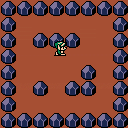
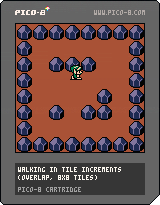
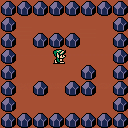
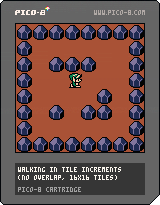
This is just a demo of some code to allow walking in tile-sized increments. The hook is that after player input, the player keeps walking until they reach the next tile.
In the first example, the walking tiles are 8x8, though the world is drawn with 16x16 tiles. The hitbox of the player is also only his lower half. This allows the player to be "in front" of things. Walk up to the bottom side of a boulder and walk left and right to see what I mean.
In the second example, the walking tiles are 16x16. The hitbox of the player is also 16x16, meaning the player can only occupy a single 16x16 tile, and can never be "in front" of other tiles.
8 comments