


Do a little sanity checking, eh? print() by itself crashes Pico-8 0.1.3 standalone because there is no first argument.


The web client seems fine, though.


 3 comments






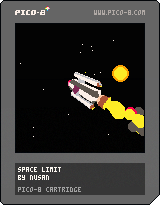
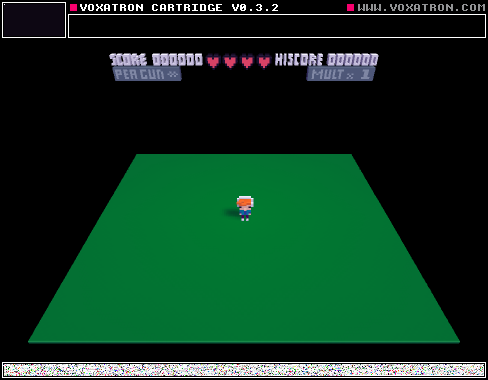
Space limit is a little 3D demo (so no gameplay yet) inspired by Kerbal Space Program.
If it's too slow in your browser, try directly in Pico8



There is nothing in the sprite/tile data, the code is (realy) messy and triangles can only be monochrome.
For this project, I made a blender exporter (based on the .ply one) that can be found here
I also made a mesh converter to vertex/index string (one byte per location, scale limited to 2.5 around origin) to import in Pico 8. I made it in Javascript (If some people want it, I could port it in the blender exporter instead).
26 comments





Hello everyone :)
I just made it public on pico-8 Slack's group. A couple weeks ago I created an api to use on my experiments with PICO-8. I used Kimono to scrape the BBS every 24 hours.
I had not made it public yet because I don't know if Zep'd be ok with that... and sometimes I'm too lazy to ask hahah. So hey @zep, are you ok with that? It makes just a few requests per day to the BBS... It's updated every 24 hours and makes one request per carts page. So I don't think it's gonna hurt the BBS's performance.
So here's the json api and here's a page with (hopefully) all carts.
And finally here's the api docs.
10 comments






Hello, world !
I have been thinking about setting up a Slack team for PICO-8.
I noticed after searching with Google there's a team created already, but it seems to be dead, and no one in the IRC knew about it.
:: EDIT
New invite system implemented. Get your invite here: JOIN !
There's also the good old invite system JTE is running on her server: (alt) JOIN !
Eternal love (<3) to JTE for running the invite automation system, and asterick for helping to set it up.
14 comments






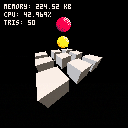
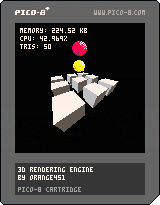
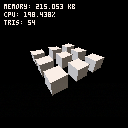
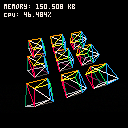





With Zep's RLE compression thingy you can now store an absurd amount of graphical data. This means short FMVs are technically possible, if unwieldy.
I don't know what to use it for besides converting porn GIFs to Pico-8's palette and playing them over an energetic chiptune backbeat, though?
5 comments



UPDATE: Hey look! I updated it (above), and fixed the bug where when the laser made contact with the enemy, it spazzed out for a second. Enjoy!(?)

Here's my first publicly-available game made with the Pico-8! It's a space shooter where you play as a Nroctrion star-cruiser, and have to fend off the evil cihptnueians and save your home-world.
CONTROLS:
Left and Right Arrow Keys to move
Z to fire
NOTE: This is an alpha build of the game. (Very few) new features will be coming.
Also, feedback is highly appreciated! Thanks :)
1 comment

Instead of just raising the script token limit, I propose that the token limit is fine. It's how they're counted that actually needs more polish. Here is one proposal for what to do:
Make commas, parenthesis, and periods/colons equivalent to whitespace.
They're actually abstractions denoting a specific correlation of two points of data, not a symbol in and of itself. If you're calling a function with two arguments, "funcname(arg1, arg2)" is actually 3 useful points of data, "funcname", "arg1", and "arg2", not 6 just because there are arguments at all.
Look to assembly code for inspiration. At the assembly level, which translates quite directly to bytecode, do you write "function, begin_arguments, argument1, argument_seperator, argument2, end_arguments" as that many different individual tokens? I don't think so. :P It's more like "push argument1, push argument 2, jump to function" isn't it? Three commands, three script tokens.
If you want to go farther, you could consider doing the same for math operations and the string concatenation operator. In the case of "x = y + 7", you have two things being added together and a third thing holding the resulting value, right? That can still be only 3 tokens, instead of 5. "x += 1" would be two tokens instead of three.
And if you want to make local variables usable, ever, make an exception for the word "local" so it doesn't count against you. :P
At that point, the token limit might actually be too [i]high
4 comments
I'll admit that I'm a bit new to PICO-8 and don't have a good handle on how it's built. Maybe other language support isn't trivial.
That said, I'd love to be able to use a subset of something like Ruby, Javascript, or Python in addition to the current Lua based subset.
Is there a chance we'll see other languages in the future?
3 comments

Hi everyone!
I'm an absolut fan of Pico-8 and I spend a lot of hours reading this forum, many of them in my smartphone or my tablet.
I love running cartridges when I have a free time (without the possibility of use my computer). And, I can't do anything because in mobiles phones or tablets we can't take a virtual keyboard when we are running a game so...
Can you add an option to pico webplayer in order to give a solution to this?
Or... have anyone any idea how to play cartridges with smartphones?
Thanks a lot!!
1 comment


Star Wars 1.0.
I gave permission for you guys to use, but please do not post a level with attached items until this game is not WIP and fully running.
Star wars 1.0 is only f
0 comments
Got pico today.
Spent the past few hours writing a bunch of matrix math in lua. To celebrate I made a perspective-correct rotating cube :D
 4 comments



Hi,
i've been thinking about something for pico-8 that could be nice: Having a kind of online high score rankings by game on the website.
Let's say the easiest way to do it first would be just in the web player on that site with logged in users.
API can be as minimal as score(value). The advantage of the opaque function is that it can redirect score anywhere (online db for webplayer, local file when ran from pico-8 sdk, silently ignored...)
This kind of feature is cool as it gives game dev more feedbacks on their games as well as increasing their replay value. Plus the community will benefit from that as it gives another axis to consolidate it.
I'm aware it is not that trivial to implement and it requires some work but I love the idea!
2 comments


Hello everyone.
I bought pico8 like a week ago after my friend kept linking me awesome stuff on the forum here. The "exercise" and "now is fornever" ones were particularly inspiring to me.
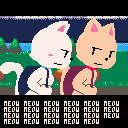
On the weekend I sat down to make this scrolling background thing and then I just kept running with it. It's mostly a ton of lines, circles, and the mod operator. There isn't much point to it. You can press left and right to change speed, press up to randomise the palette, and down to reset those changes.
EDIT: 42 stars!
 37 comments



Here's a fun little project. By "fun" I mean "nightmarish" and by "little" I mean "countless hours of headaches".
Let's network a Pico-8 cart.
This operation involves careful controlled management of the game state and manipulating the player controls with a wrapper. If we're using an HTML5 build, we can already manipulate the player inputs with JavaScript trivially enough -- there's an API explicitly for that one purpose. It also doesn't sound too hard to pause the game whenever controls haven't been received, although keeping a frame-perfect lockstep sync might be a hassle in itself.
But the BEST networking would involve allowing the local game to run a few frames ahead of the networked player and carefully revert and re-run those frames whenever changes in input are received, so that the game still runs full speed and remains synchronized with just a little bit of reality-bending when there's latency. This requires a deep, deep control over the entire game state, and the ability to run the game (without rendering) much faster than it's intended to go.
Fun.
Maybe I'll try it sometime. The license explicitly states I'm allowed to alter and use HTML5 cartridges for any purpose. If I can't hack around that, maybe I can make my own Pico-8 emulator that runs off of the .p8 text format files... although that seemingly falls into the legal grey area of the license a bit, since it would technically require fabricating a 16 color palette and sound waveforms similar enough that they could be considered a derivative work or some such, ... unless I read the same data out of a JavaScript file generated by the HTML5 exporter...? Gah.
That's enough rambling for now. This post is just a reminder for fun things to try whenever I'm bored next.
17 comments


Lua has a peculiar block syntax for multi-line strings. It looks like this:
game_backstory = [[ Once upon a time, the wind was blowing, kicking the sea up, nice and wavy. The tide swept in, a darkness came, and everyone drowned in sweet gravy. ]] |
Unfortunately, this makes Pico-8's code editor freak out and try to parse the entire string as individual numbers and words and stuff, grossly aggravating the token count. Plus I can't type \n in the pico-8 editor, despite the character being available in the font.
I'm already using both, since \n makes a great delimiter for writing human-readable data.

There was also a multi-line comment syntax based on it, where you could write
--[[ comments on multiple lines ]] |
4 comments
IMO instead of single license checkbox, you should be able to select by mutliple checkboxes the kind of CC license you want for your game.
So, by default it'd be CC0, but then you could check each part of CC license, so you can have any combination of by nc sa nd.
1 comment