





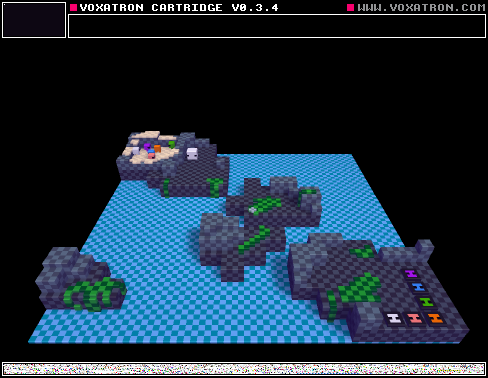
This is something I like very much. Bring the voxlings to safety no matter the cost. Voxlings lost will remain lost for the rest of the game. Although it gets rather tedious.
There is only one winnable level compared to the twenty planned. It will never be finished. Sorry.


 2 comments



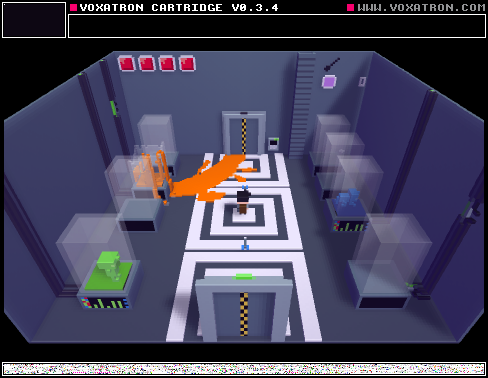
This was what I worked on when version 0.3.4 came out.
It is an advanced version of "Voxatron Bowman."
There is only two rooms. There were many more planned, but I'm never going to finish them. Sorry.
0 comments


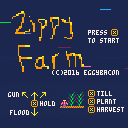
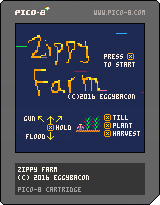
ZIPPY FARM
by EggyBacon
I decided to move out of the city and become a farmer.
How hard can it be, right?
Good thing I'm a fast learner, because each season only lasts 12 seconds.
I'll be rolling in fabulous crops in no time.
What the...WHERE DID ALL THESE CROWS COME FROM?
WHY ARE MICE CHEWING UP MY FIELD?!
4 comments




I did a small patch to SDL2 that should fix using the custom glyphs in 0.1.9, so until 0.1.9b is released this should suffice
This also fixes getting a ding/beep sound when trying to use the custom glyphs, the version of SDL2 that ships with PICO-8 is too old
Changed:
https://gamax92.keybase.pub/CustomSDL2.zip
No idea if this change adds in any issues but I've not been able to see any.
7 comments






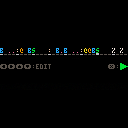
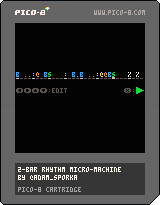
Here are two approaches to a micro rhythm machine: Programmable Sequencer (specify the rhythm, then play it) and a Real-time Sequencer (push the keys at the right time to record a rhythm).
PROGRAMMABLE SEQUENCER
Left/Right: Move cursor
Up/Down: Specify which instrument will play
X: Play/Stop
Update 2017-04-25: Better feedback during editing.
REAL-TIME SEQUENCER
A really simple beat machine with real-time performance recording and playback on a two-bar loop. The metronome can't be switched off and the tempo can't be set. And the playback can't be paused/restarted. Also, only one drum can sound at a time. Still fun!!
The latency between image and audio is kinda hindering its feasibility, especially when run in a browser. Sequencers as music makers in PICO-8 are perhaps better approach, e.g. 4-beat by 4mat. Anyway, step editing would be cool though and I'll add it later (and some fancier graphics along with that).
3 comments


This function abuses Unicode and ANSI color codes to output a screenshot of the current screen to a text terminal such as xterm. You can record the PICO-8 rendering and replay it using “cat”! You can run PICO-8 over ssh! You can be anything you want.
I also set up a telnet service demonstrating the feature:
telnet lol.pm 12345Here is how it looks like; this is PICO-8 (small window) launched from GNOME Terminal (large window) just after screenshot() was called:
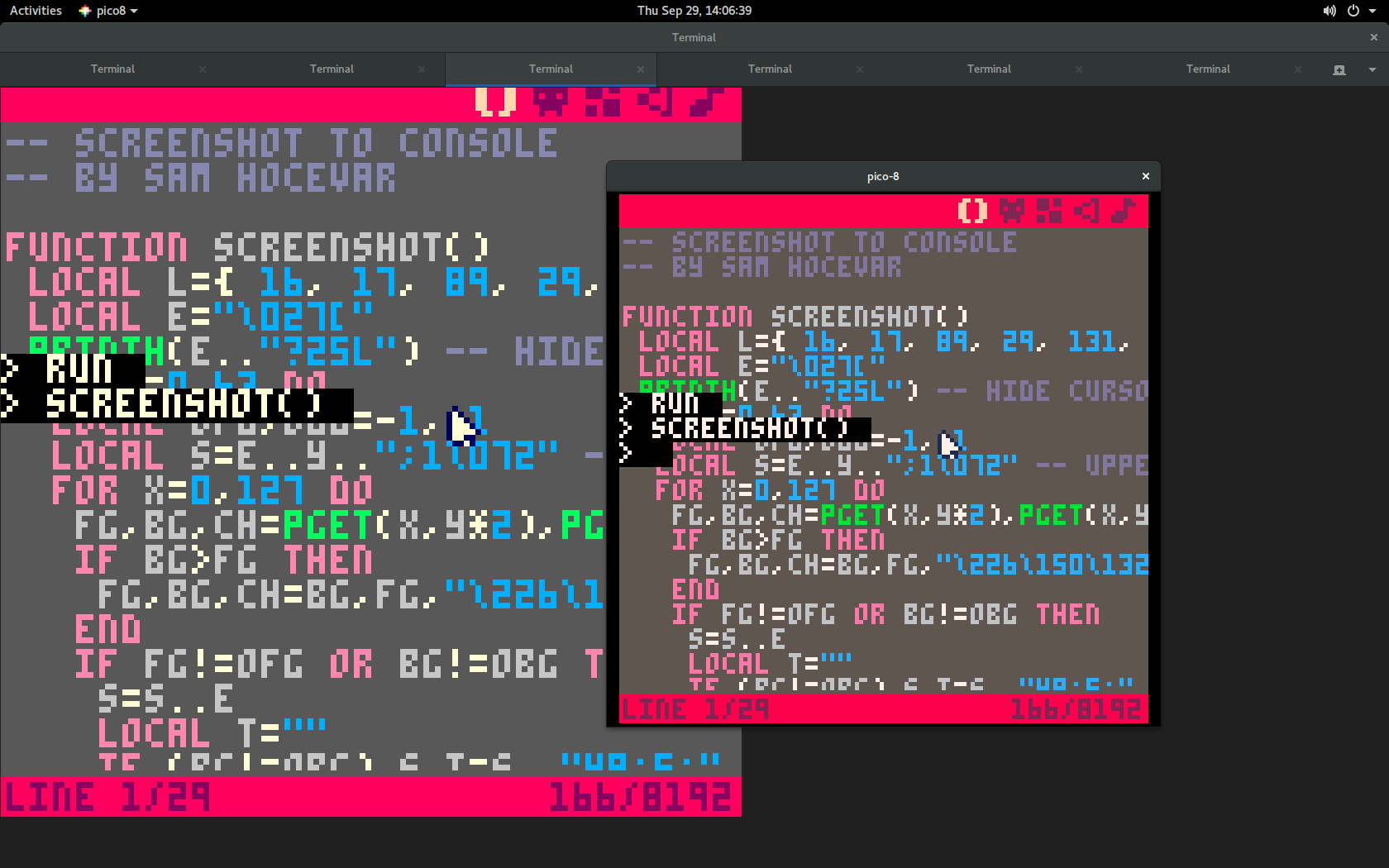
And here is the code:
pico-8 cartridge // http://www.pico-8.com
version 8
__lua__
-- screenshot to console
-- by sam hocevar

function screenshot()
 local l={ 16, 17, 89, 29, 131, 240, 251, 230, 197, 214, 220, 47, 39, 103, 211, 223 }
 local e="\027["
 printh(e.."?25l") -- hide cursor
 for y=0,63 do
  local ofg,obg=-1,-1
  local s=e..(y+1)..";1\072" -- uppercase h
  for x=0,127 do
   fg,bg,ch=pget(x,y*2),pget(x,y*2+1),"\226\150\128"
   if bg>fg then
    fg,bg,ch=bg,fg,"\226\150\132"
   end
   if fg!=ofg or bg!=obg then
    s=s..e
    local t=""
    if (bg!=obg) s,t=s.."48;5;"..l[bg+1],";"
    if (fg!=ofg) s=s..t.."38;5;"..l[fg+1]
    s=s.."m"
   end
   s=s..ch
   ofg,obg=fg,bg
  end
  printh(s..e.."0m"..e.."\075") -- uppercase k
 end
 printh(e.."?25h") -- show cursor
end
|
The terminal must be UTF-8 and 256-color aware, so this will probably work in most Linux and OS X terminals. On Windows I could test it successfully with the MSYS2 terminal.
2 comments


3D test & Sprite data converte
https://www.lexaloffle.com/bbs/?tid=27767
Add a text data output in the "PICO-8 Palette Mosaic"

PICO-8 Palette Mosaic
http://www6.plala.or.jp/TimeTripper/html5/pico8.html
0 comments
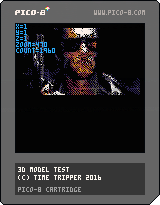
This is a 3D test program.
Rotation with the cursor keys (Z, Y)
Z, X key zoom
To retrieve data from a sprite sheet.
Sprite data is converted by the "PICO-8 Palette Mosaic"
PICO-8 Palette Mosaic
http://www6.plala.or.jp/TimeTripper/html5/pico8.htmln
2 comments
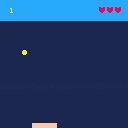



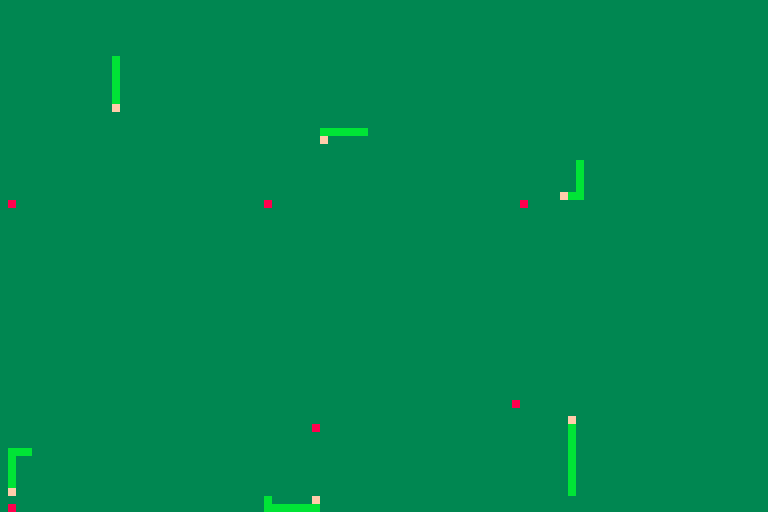
Will be a mix of "Metroid" and the classic cellphone game, "Snake". Not much there at the moment.
 1 comment


Hi,
Pico-8 already works on Windows, Mac OS X, Linux and Raspberry, but are there any plans to release it on Android too? If so, any tablet with a physical keyboard (or even virtual keyboard?) would then make a marvelous take-it-anywhere game making platform! I already own a pocketCHIP but the screen's a bit small. I can totally see a 7" tablet being the perfect size: not too small, not too big. And, maybe with the help of a pen, the touchscreen might be precise enough to not need a mouse. Imagine how it would be nice to make games and play them anywhere... Any thought or info on this?
3 comments



Forgot to post this here the other day: PICO-8-Token-Optimizations
Lots of people working on larger projects (or more topically, the collab16 games) end up hitting the token limit, and people in the PICO-8 community have come up with plenty of handy tricks to deal with that. Some of them are common knowledge or pretty easy to figure out on your own, but others are a bit obscure, so I figured it'd be useful to compile a list of general purpose tricks and techniques for cutting down your tokens.
If you know of any handy tips that aren't listed or have any corrections/improvements, feel free to let me know or contribute to the repository!
7 comments



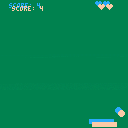
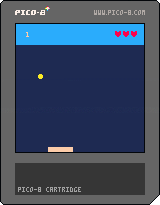
Of course this is based on the Picozine #1 tutorial, but I really customized it, and I think it's now interesting to play it.
Every 5 points you get a life.
If the ball hits the paddle at left, then it goes left,
and if the ball hits the paddle at right, then it goes right.
But you'll never be able to get it into a perfect vertical movement, so, no infinite score by doing absolutely nothing!
1 comment

PRESS C TO BLOW.
CTRL + R TO RESET (but you knew it).
Well I'm experimenting with sprites, animations, loops, in other words, with Pico-8.
It's fun and easy, really awesome.
Yay! First cart uploaded! /o/
4 comments

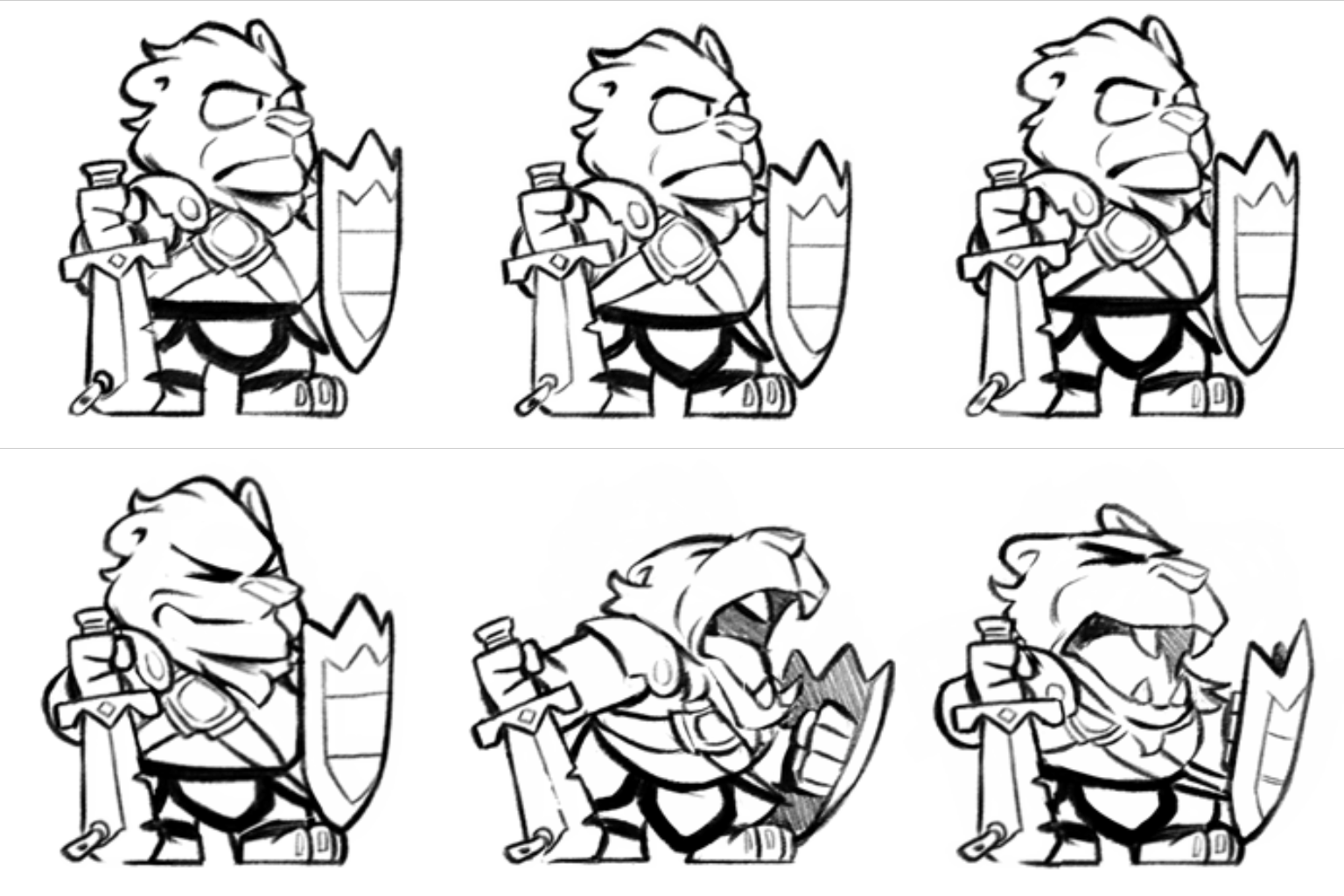

Proposing a DKC inspired cart, based mainly on the funner parts that DKC is known for. Priorities: Barrel Cannon sequences/mazes, mine cart levels, rocket barrel levels, maybe bird buddy / flying or fish buddy / swimming stages... and then maybe after all that, if there's space left... we can squeeze in some platforming.
Takers?
3 comments

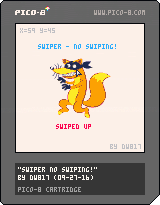
Update (09-28-16)
- Set it to clear message if invalid swipe
My friend Chris has a great cellphone. It's touch-screen and he was showing me a feature I didn't know about called SWIPING. That is, you take your finger on the phone and drag it up, down, left, or right - quickly, and it registers as changing pages.
With the advent of PocketCHIP's -ahh- marvelous keyboard, I suspect users of the device will be more interested in carts that take advantage of its touch-screen technology.
I thought about it for a second, determined you needed to have some tight triangles for movement and am seeking that. Here is a picture of what my code is looking for:
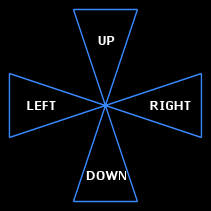 2 comments

Yep, some more casual observations by dw817.
Just a suggestion for the FORUM. Can add a NEXT or PREVIOUS when reading BBS messages to go to the next or previous initial BBS message that was written.
Signature lines for the forum anyone ?
Errors (or problems) I found:
local a,b,c -- accepted
local a=3,b,c -- accepted (This method is listed in LUA help)
local a=3,b=2,c -- error
local a,b,c=3 -- read wrong, number stored in "a"
Loading code currently includes loading any spaces that might be inadvertently added to the end of a line.
Suggest in loading they be truncated, I.E.:
One line could read:
"cls() " -- and have 2-spaces on the end. This is saved when the source is saved.
Loading a code could truncate this:
"cls()"
Or even in the EDITOR, automatically truncate leading spaces as they are not needed.
While they don't count in TOKENS, they =DO= count in source code bytes used of the available 65536.
Since the code editor's top-left-hand corner of the screen is blank, it could include information including the name of the last saved file. This would be useful when working with two-different PICO files that are open in two PICO editors so you don't confused as to which is which.
Suggest that anything between --
0 comments


