




My very first PICO-8 project. It's a drum machine! Turns out little PICO isn't very good at keeping a beat, but it's kinda cute that he tries his hardest anyway :)
This is v0.1, more updates will come soon as I continue to learn. Enjoy! ^.^
Updates
0.1 - Original Upload
0.11 - Fixed pattern length being able to underflow. Whoops!


 0 comments

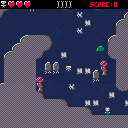


So, I just found out while making my space invaders clone that the way I do waiting in Hackers (the rpg) could be extremely simplified, and will require mass redesign if I want to improve token count. Shit.
3 comments


Writing this after seeing Alone in Pico feels like being the band that plays right after the Beatles. It is friggin amazing. Here's the game: https://www.lexaloffle.com/bbs/?tid=3792 and here's my reaction right after playing it: https://www.youtube.com/watch?v=gXN1yxax448
Yeah, it's good. So, what am I up to then?
Well, the Most Amazing RPG On The Pico-8(TM) is going good. currently working on the overworld (what I'm currently dubbing "Cyberspace"). This world is where a good portion of the game will take place. It's a little camera-shy at the moment, though, so I think I'll show it off when it looks a bit more presentable. Recently, and unfortunately however, I've gotten into a bit of a funk in regards to the game. So, in the mean time, I've started a space invaders clone, just to see how quickly I can do it. Groundbreaking stuff, eh? :P
Anyways, that's about all that's up with me in regards to the Pico-8, so I guess this is where the post ends. more will (hopefully) follow in the near future. Live long and prosper.
-Rudlin, 2016
0 comments




Plan :
- Inception
- Gameplay
- How to render 3D meshes in Pico 8
- Pre-rendered magic
- Extracting meshes from Alone in the Dark
- Character animation
- Memory layout, packing and ram management
- Camera placement, tools
- Interactions, objects animations, sounds
- Optimization
- Triangle strips
- Future
Disclaimer : my english skills are a bit low and I wrote that post a litlle too fast ...
The final project can be found here
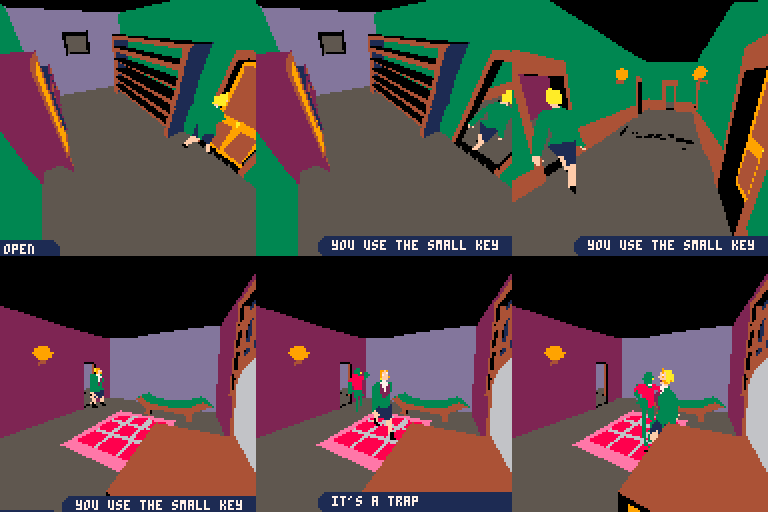
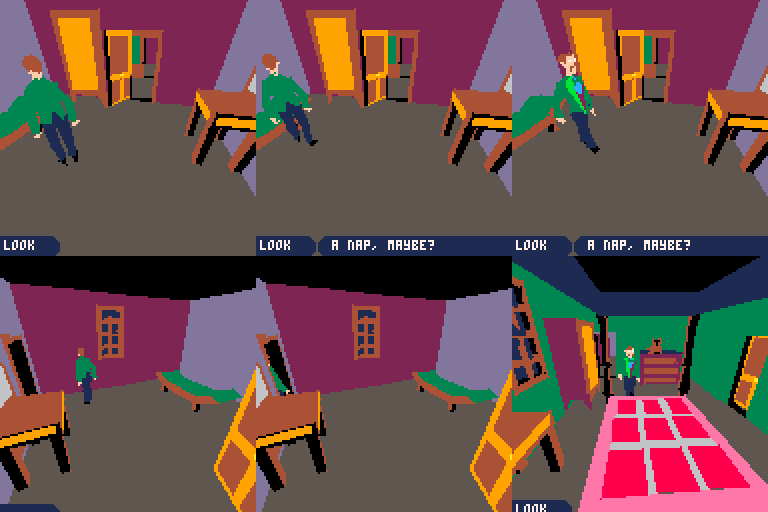
1. Inception
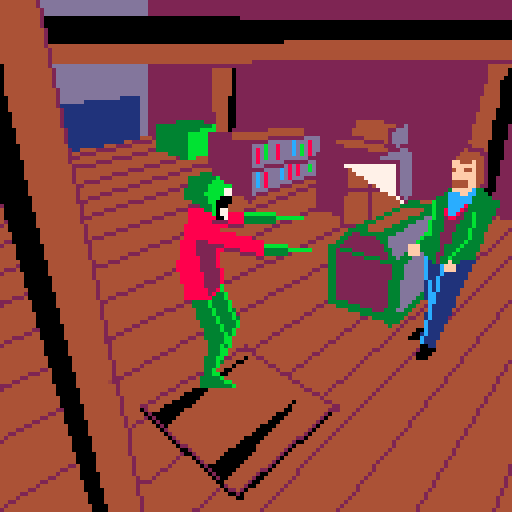
The idea of making a Pico 8 demake of the classic cult game Alone In The Dark started at Halloween 2015. I was searching for a mockup to do using Pico 8 color palette, and Alone in the Dark seemed a pretty good fit. After looking at it, the original is a lot more detailed than what would be possible in Pico 8. Getting from like VGA 256 colors to 128x128 16 colors would not be easy. But the mesh complexity in Alone in the Dark seemed doable in Pico 8. I had just finished a small 3D demo in Pico 8 so I knew that I could probably draw the character at 30 fps and pre-render the background.
The mockup that started everything :
 16 comments



Hello!
I've been playing with Pico-8 for a few days now and love it! Here's my first effort.
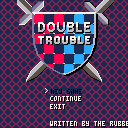
The aim of the game is to get the two knights to the big trapdoor (with the key) to escape the level. You control both knights at the same time. The right knight follows your keypresses as you would expect, but the blue knight does the opposite.
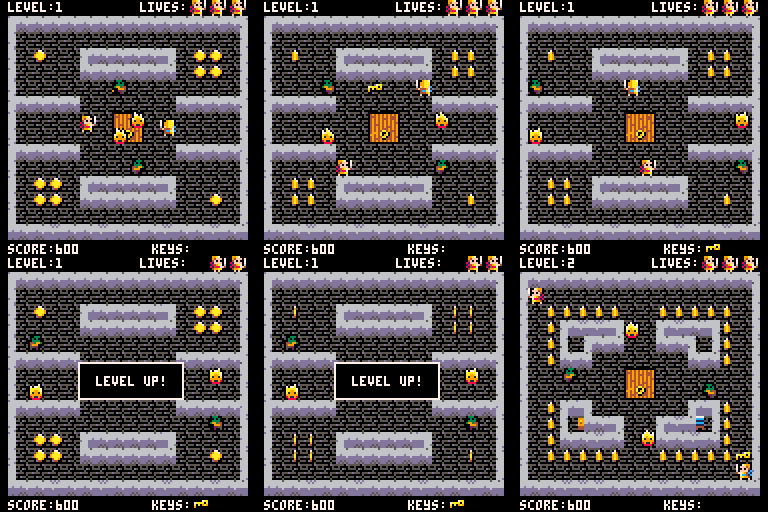
I've learnt a lot about Pico-8 while writing this game... mostly what not to do next time. For sure the code could easily be refactored and a lot of duplication removed but thats for another day.
Anyway I hope it gives you a few minutes fun.
Cheers,
RKK.
4 comments



Re-familiarizing myself with PICO-8 :)
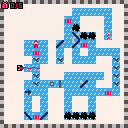
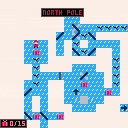
Rewrite of the old version for PICO-8, written with some better practices that allow me to do things like have a title screen and a win screen. Except the win screen doesn't seem to work for some reason :(
I also added an actual tutorial instead of just throwing you in to the final level. Still need to add some more levels before I'd consider it finished though.
 3 comments


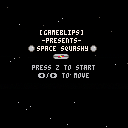
I'm officially putting up this "hack" of the original Squashy code from PicoZine 1. We all have to start somewhere, right? I've replaced the basic ball and paddle with full sprites and added a map to show stars instead of just the flat green background. The reason I am versioning this not quite at 1.0 is that I really want to get the Game Over screen proper instead of just looping back to the splash screen. Other than that, it's completely playable!
Z to start
Left and Right arrows to move
1pt for getting a wall bounce
10pts for not losing a ball
0 comments

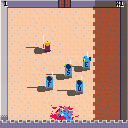
A game about fencing and castle, with trolls.
Press the letter keys to attack the trolls, and the arrows to dodge. Post your scores :)
7 comments





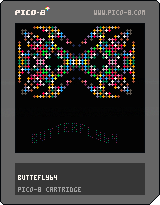
Found out about PICO-8 just the other day. Did allot of assembly programming on the C64 in the old good days. Thought I would give this "Fantasy console" a try. Since i never written a line in LUA before I was thrilled over how easy it is to understand the basic idea about programming for this machine. Yesterday I spent abou 5 hours (1 hour on read thru the forums and the manual) and then the rest of the time to write a simple demo for PICO-8. It's a a convertion of a BASIC demo i wrote in 2010 for the C64.
0 comments
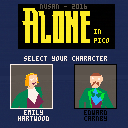
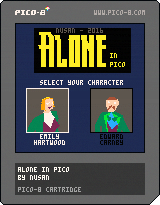
"A suspicious suicide. A chilling curse. A malevolent power. And a wicked dark secret. This is Derceto ...
Choose between Emily Hartwood and Edward Carnby to explore this virtual adventure game inspired by the work of H.P.Lovecraft."
Controls : Arrow keys to move, 'c' or 'v' to interact
Music can be turned off in the menu ('enter' key)
I wrote a (long) post-mortem of this project : here
This is a small "demake" of Alone in the Dark. You can explore and find your way out of the top two floor of the mansion. I tried to keep it close to the original, but there is no fight (if you see an enemy you will die) and the interaction system is simpler. The 3D meshes of the characters are ripped from the original game.
41 comments






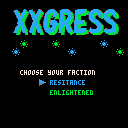
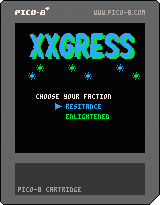
cursor keys : move
[Z] key : attack (fire a burster)
[X] key : create a link
1 Choose your faction (color) first.
2 Visit portals scattered in the field.
3 Then you will get bursters and keys (yellow symbols on portals).
4 Attack enemy color portals and make them your color.
5 Create links to portals whose keys you have.
6 Create triangles by links.
7 Area of triangles is called MU.
8 Make your MU larger than enemy's
9 After 7 days, if your MU is larger than 100MU+enemy's MU,
you will win the game.
Good luck.
Prizes
liberator : how many portals you changed their colors
connector : how many links you created
mind controller : how many triangles you created
Illuminator :how much MU you've aquired
explorer : how many portals you visited first
pioneer : how many portals you changed their colors first
hacker : how many times you got items from portals
5 comments


Hi,
Does anyone know of a unit testing framework for PICO-8? If not I'll see if I can get a simple system up and running.
--Graham
1 comment


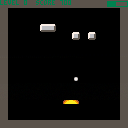
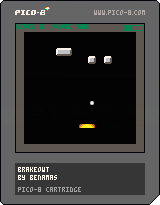
a playable but (currently) boring breakout clone
- press z to launch a ball, and left and right to move the paddle in an effort to keep the ball in play as it breaks bricks
- break 10 bricks without losing to CHARGE UP the METER
- press Z with a full meter to launch a SECOND, THIRD, ETC... ball
- there are only 4 levels and they repeat
still very much in progress... work on this is slow cuz my day job sucks all my energy out and i only really code on the weekends
old versions: cart 24831, 25020, 25448
2 comments


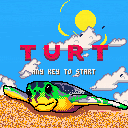
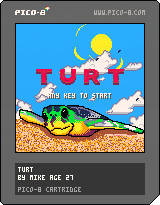
Mother Turt has laid her clutch and left them to find their way to the sea! Avoid crabs and seabirds to escape.
Left/Right set turt's direction
Up/Down switch between selected turt
A/B Menu confirm
I drew the main turtle in photoshop. Thought I'd add the script I wrote to import it. Provide your png, cart, and sprite index and it does the rest:
https://github.com/Jigglebizz/pico8scripts
I'm not planning on working on this any more. I got what I wanted out of this project. If you'd like to work on it, the source is available on my github:
https://github.com/Jigglebizz/turt
8 comments


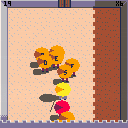
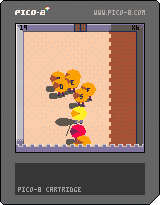


I have a routine where I'm checking a pixel color at a certain x/y to determine whether or not to place a new sprite there. If it's black, it's open; if it's white, it's unavailable. I'm doing this in the _update() loop but I'm often getting cases where it'll place a sprite twice in the same place rather than just once.
After going through my code again and again, it struck me that having the pixel check in the update() might not be the best place. Wondering if doing pixel checks in the draw() are more reliable because there's cases where update() could be slower/faster than draw()...?
I chose to do pixel checking to avoid having to loop through an array checking x/y coordinates every time but it sounds like that may be more reliable?
Any thoughts/insight is appreciated.
4 comments

