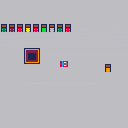
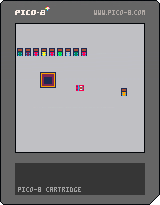
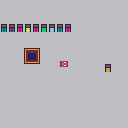
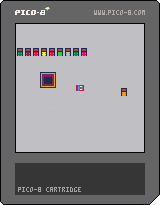


Agh ! It's ... well, maybe hideous is saying too much. In any case it certainly doesn't belong there.
Here is a screenshot of the mapper. I was experimenting with a box for a set of rooms that are 3x3 8x8 sprites in size.
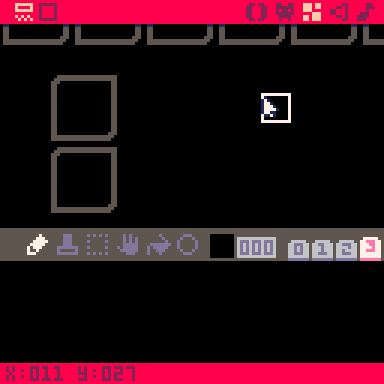
No problem here.
But now watch what happens when I scroll up by one tile.
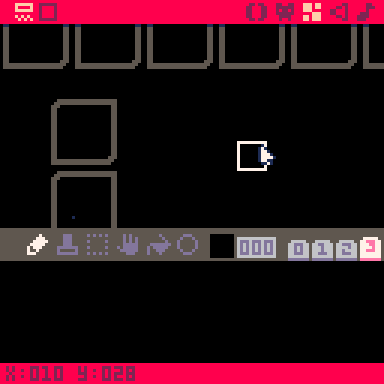
The dot appears ! I know this dot is used to denote that a tile you chose in the mapper may be black but is not the first tile #0.
In this case it most certainly is tile #0 so it should not be appearing, @zep. And it only appears in this instance.
So for it to appear depending upon which part of the map you are viewing is incorrect and definitely an error.


 6 comments





I've been getting really into PICO-8 development in the last two weeks, after having spent years mainly just playing the games. I have only the lightest background in programming (like coding microcomputer BASIC programs when I was a kid), but I understand a lot of the principles behind it, and in game design. I'm also pretty handy with a spreadsheet and have produced some fairly sophisticated things using Google Sheets code.
Anyway, Krystian pointed me to Delunky as a good example of procedural map generation for platformers, and someone else showed me X-Zero. I opened up both of the carts and took a peek under the hood. I'd just like to pick your brains if you all have a bit.
So, what I gather is that the fourth tab of the sprite sheet contains a bunch of tiles that represent mini-versions possible rooms. The game draws the level elements (platforms, walls, traps, and such) by reading the colored section of the mini-tiles and extrapolating the larger elements onto the playable area of the map, is that right? Also, it looks like the mini-tiles aren't necessarily 1:1 representations of the full rooms, but that the process for determining platform placement uses RNG based on the mini-tiles. So that let's say a pixel of color 7 might not always generate a tile on the playable map, but that the RNG has a decent chance of putting one there.
1 comment
Hello.
I was just copying the source-code from one of my later projects and ran into an interesting problem.
Here, try this out:

Runs great, right ? But now click Code▼ click anywhere in the source-code field, press CTRL+A, then CTRL+C, then in a new Pico-8 boot, in the source-code editor, press CTRL+V.
cls() repeat るきるきpset(rnd(128),rnd(128),rnd(16)) るきるきflip() untilるきforever |
るきるき ⬅️
What is happening here ?
It looks like SPACES are being replaced by some other characters. This does not just appear for me but any code you try.
Clearly it's a bug of some kind.
2 comments






.jpeg)
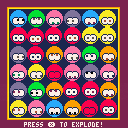
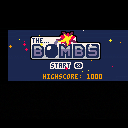
Look at those cute little fluffballs, I sure hope they don't explode into a huge display of colours!
Chuzzles are very peaceful creatures, however, their friendliness can be their biggest downfall. If they are with a group of 3 or more friends of the same colour, they will explode into a cloud of fur.
Version History
1 comment
I'm sure this has been asked multiple times, but I couldn't think of the right combination of keywords to find it.
I never bothered with learning about memory stuff, but for efficiency I might need it.

This is sitelen pona, a writing system I am planning to use for a game. A glyph is 7x7(8x8 including borders), and so far I have a total of 132 characters.
I would like to know how I could
- efficiently store the glyphs(I can convert them into hexadecimal strings)
- have an efficient way to render them on the screen, with specified color
- have a way to store dialogue data, and render strings of characters
I'm sure I can find a way on my own, but so far I haven't had luck with the rendering part, and I'm also worried that it might be inefficient
5 comments



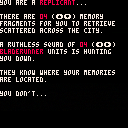
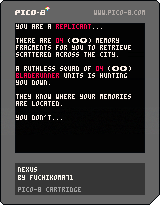
In NexusZero, you play as a Replicant in Philip K. Dick’s/Ridley Scott’s/Denis Villeneuve’s (take your own pick!) Bladerunner universe. The objective is to recover several memory fragments scattered across the city. While looking for these, you must avoid Bladerunner patrols (or escape them once detected). These are marked by flickering yellow lights, unless they are chasing you (i.e. you have been detected), in which case they are displayed as flashing blue and red lights. Obviously, your own location is the centre of the green crosshair.
One twist is that the Bladerunners know where your memory fragments are located, whereas you initially don’t. They will show up as pulsating green square icons once you have come close enough to detect them. When following normal patrol routes (i.e. when they are not chasing you) Bladerunner units visit the corresponding locations at irregular intervals, so observing their movement patterns may give you a hint as to where the fragments have been deposited.
5 comments
Hello !
With the arrival of Picotron comes a great system with a great many errors too. :)
🇵
I am using this symbol in my title until the category "Picotron" has been created. If you want to post your own Pictron code, in absence of a category you can use that emoji too. Just double-click it, press CTRL+C, then CTRL+V to paste it out later in your Picotron title.
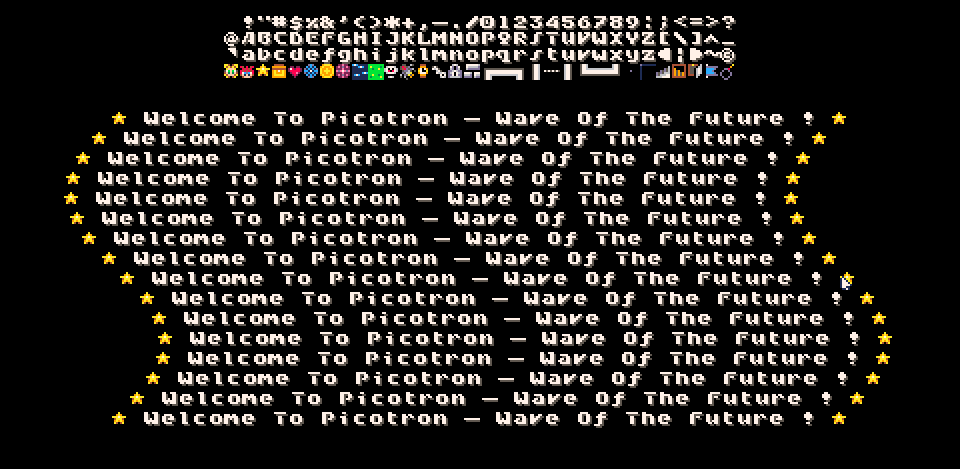
Functions are now working and I did manage to write this to demonstrate how to access a multiarray image both in main code and a function. You are also welcome to use the font and sprites I drew and code I typed in your own Picotron projects.
Here now is the code you can try out in Picotron for the display above which includes the 1-line function to display custom 8x8 font + sprites in your own code. First highlight all of the code you see in white below. Move the mouse pointer so it is touching just before the first "-" and holding down the mouse button drag the mouse down all through the code. Let go when you reached the bottom line. Then let go of the mouse entirely.
11 comments


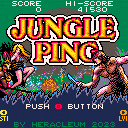
Pico-8 demake of the classic arcade game Jungle King (by Taito 1982, shortly after renamed as Jungle Hunt, Tarzan replaced by an explorer)
Controls
- 🅾️ [Z] Action (Jump or Stab while underwater)
- ⬅️⬆️➡️⬇️ Movement, depending on stage:
- Stage 1: none, just jump from vine to vine
- Stage 2: swim in all directions while underwater
- Stage 3: ⬅️ run faster, ➡️ slow down (they can be used during jump) and ⬇️ to duck
- Stage 4: ⬅️ walk left, ➡️ walk right (no influence on jump)
The Game
It is divided into four different stages:
- jungle and swinging vines (with monkeys on harder levels)
- swimming in a crocodiles/alligators-infested river
24 comments






Hey @zep,
I tried exporting and running an app, didn't do anything special except to load up a working cart and type "export blahblah.bin" and then run the resulting executable from the blahblah.bin/windows/ folder, and the window came up offscreen.
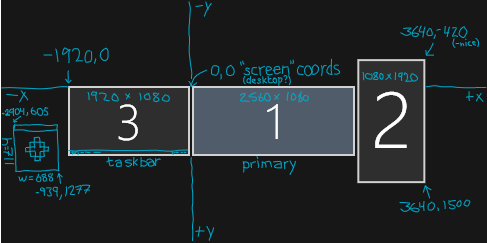
I used some tools and also some estimates to figure out where the app actually came up, and I'm pretty sure it's because I have a rather uncommon desktop arrangement.
Here's an image showing my desktop arrangement from Windows' display settings, with all of the extra info I found/deduced annotated and the position of the exported app when it launches. I hope this helps you figure out where you, e.g. copy/pasted some math and flipped or repeated a coordinate:
(sorry, it's hard to write with a mouse)
Also, just in case it matters, I launched the app from a windows explorer window on the center/primary monitor.
Let me know if I can offer up any more info to help you track this down.
0 comments

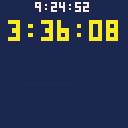
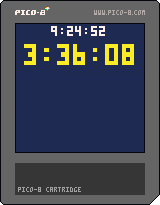
I was just messing around and misnamed the directory name and when I went to go hit tab to autocomplete it instead of seeing there's no directory named that it spewed this random garbage at me. It seems to be the same data everytime except it's randomly initialized when I open the .app.
I'm on mac 2.0.5e
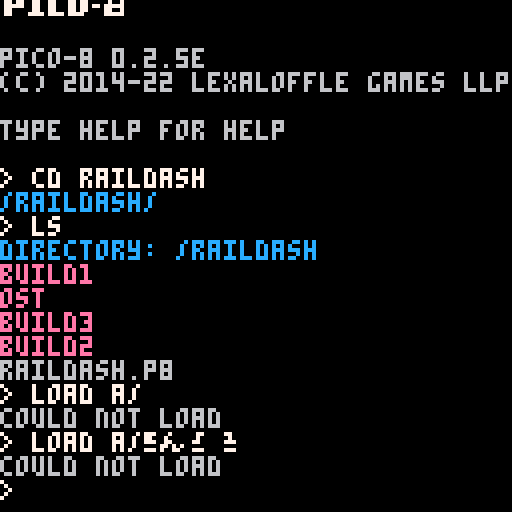
(I think this has been fixed?)
1 comment
Happy new year everyone!
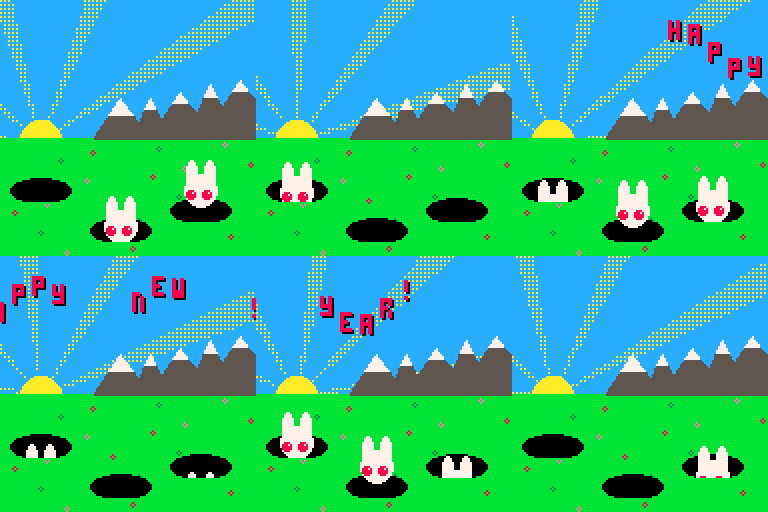
One of the things I want to do this year is to write more pico8 programs, and share what I do here.
In the last few days, I've been following LoveByte's TinyCodeChristmas Series, with the goal to write a pico8 new year's card. This is the result!
The mountains turned out kinda weird, but other than that, I'm happy with the result. Here is the card, feel free to hack it.
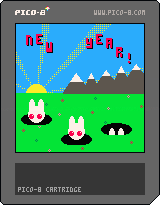
Next, I will try to complete LazyDev's Schmup tutorial by the end of February. Let's hope it works!
And also check out this BBS more :-)
2 comments

Random Talk, Interview With Ericb - Pico-View #4
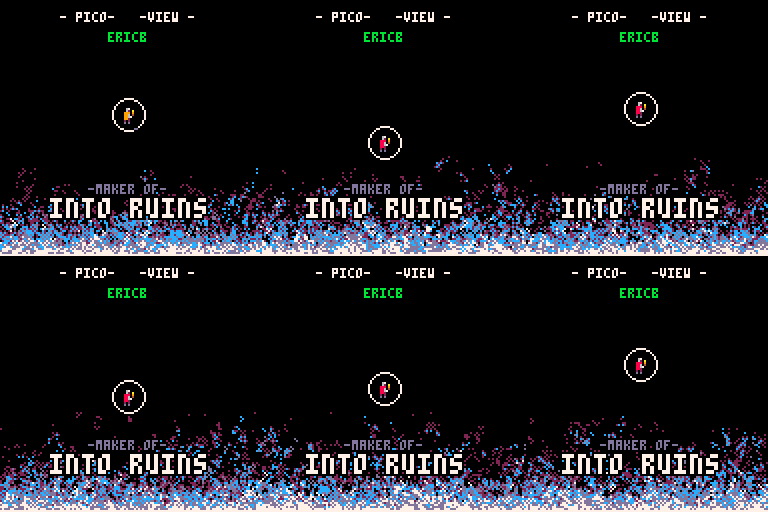
EricB:
EB = EricB

Marina:@MarinaMakes
M = Marina

Their games:
Into Ruins (click link)
Interview:
M: So, @ericb who are you and why are you on Pico-View?
EB: So Hi, I'm Eric Billingsley. I'm an indie developer based in Canada, and I've worked on games like Tunic and Cuphead, and also my own games like Spring Falls. I started playing around with PICO-8 a few months ago and making Into Ruins, a roguelike. Which is mostly what we are going to talk about I think?
M: Wait, really? You worked on Tunic and Cuphead? Like 100% of my research for this was playing into-ruins.
4 comments


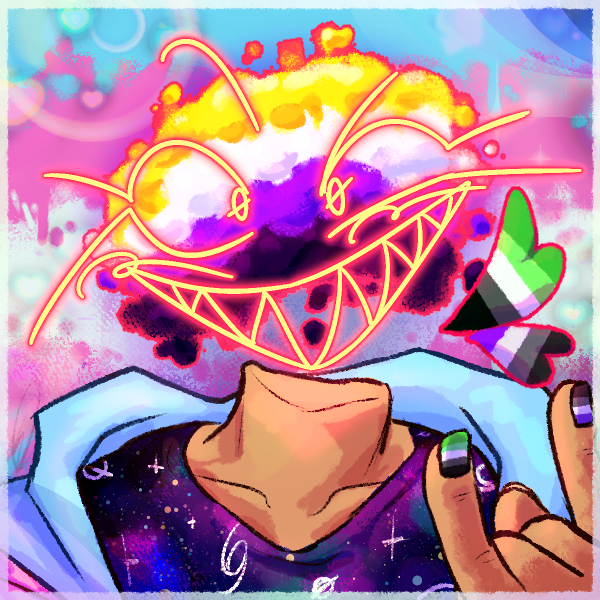
i made a new profile picture for myself, because
- i got the idea to draw a lavender-colored figure with a spiral on their belly as my profile picture
- i found this idea too cute to not do
because i use this website just for PICO-8, i wanted to make a profile picture that can be shown in PICO-8
tools
i did not use PICO-8 as my only tool.
just like with most PICO-8 cartridges that i make,
making and referencing mockups in Pixelorama is really important to save hours of time
limitations
i could not find a color combination with the PICO-8 extended palette that leaves the important details visible (according to my color contrast table) that has the figure in lavender.
so i changed the figure to purple — a color that is close enough to lavender that it still looks great
1 comment
Hi guys.
I'm not going to call this a bug cause it really isn't. However it is pretty inconvenient.
In light of the recent data compressor I wrote:
https://www.lexaloffle.com/bbs/?tid=50713
I am required to encode characters "0" (zero) to "9" as "\48" to "\57"
Why ? Well quite simply the system recognizes that \0 to \9 are read as single characters. So suppose you wanted to have character CHR(4) and character "8" in a string for data.
Well normally you would encode that as "\48" but now you see the problem. That also makes chr(48) which is character zero.
What I propose is, and you can make it optional, that "\" followed by a digit is disallowed as you can use \" for character 34 and all other non-printables like chr(10) and chr(13) already have equivalents.
This is controlled inside the code itself, possibly with an obscure POKE or even the command, nnbd() for "No numeric backslash definitions."
10 comments