


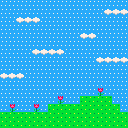
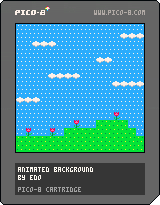
I looked into animating static background elements using different sprites and came up with this cart.
Has anyone else tried to animate the background this way (that is without parallax scrolling, just animating some background sprites)? If so what approach would you recommend?


 2 comments


Here is another song for yoooouuuu
10 patterns, 8 song slots, 3 channels
https://github.com/0xabad1dea/glorytales/ more creative commons music from me
I really like this one, I think I will also make a high-fidelity version
4 comments





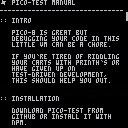
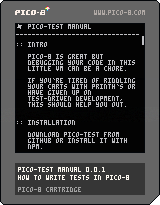
Recently, I got really tired of writing buggy code with prinths scattered everywhere to try and figure out what the hell was going on. So, I created a way to test your carts while they run. It gives you output on the command line that looks something like this:
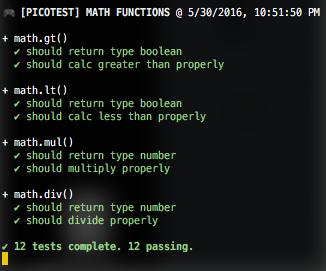
Hopefully, it's not too difficult to install/use. I mimicked mocha's API at a high-level.
I'd love to hear what you think if anyone decides to try it out. You can also download the cart and take a look at the code for more info. There's fairly detailed documentation on Github:
7 comments





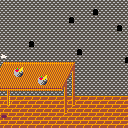
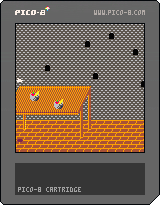
Dunno what causes this weird effect to happen.
Wait about half a minute or so and look at the plane and watch the wall background closely and how things move.
Note that I didn't employ any parallaxing and the only sprites are the plane and the shadows. Yet, at times, especially when it speeds up, things in the background (floor/wall and table/images) seems to be moving at different speeds and sometimes even in different directions. Weird optical illusion/bug in p8. Or I may just be tired and seeing things.
6 comments



Could it be created so we could produce standalone .exe versions of our games? Basically it would be just regular standalone Pico8, but without devtools (splore, etc. would stay tho). The thing is that webplayer has its limitations compared to standalone and in some cases the webplayer version of cart is unplayable while standalone is working fine.
1 comment

Any chances of manual, at least on site getting index and links, using a href and a anchor html tags? I mean, it would make it easier than having to scroll down in order to get to the section you're interested with.
3 comments



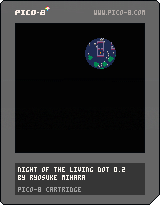
prototype of a Resident Evil-ish game.
Controls
arrow keys: move
z: shoot
x: restart when you are dead
2 comments




Pretty basic notion, but I'm falling over on this...
With a sprite that has a starting X,Y and a speed, I'd like the sprite to remain on screen.
However:
-- locks sprite off screen after passing the screen boundary
-- if btn(0)
--and x<128
-- then//move sprite
-- if x < 128
-- then
-- x=x-speed
-- end
-- end
-- locks sprite centre screen
-- while x < 128 do
-- if btn(0) then
-- x=x-speed
-- end
-- end
6 comments


Just out of curiosity, how close does my attempt to implement pset() come to the built-in version? Mine appears to be slower.
function my_pset(x, y, c)
  addr = 0x6000 + shr(x, 1) + shl(y, 6)
  old_val = peek(addr)

  if (band(1, x) == 0) then
    new_val = c + band(0xf0, old_val)
  else
    new_val = shl(c, 4) + band(0x0f, old_val)
  end

  poke(addr, new_val)
end
|
2 comments




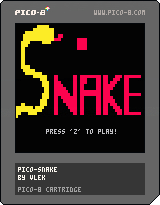
Here's my version of snake. I have it done enough to say it's a fully-fledged version. Yes, I know my graphics aren't the best, but I was more focused on creating the best version of snake I could and be as economical with the processing as possible. If you're in need of an idea as to how to create a random generator that has to take into consideration where other objects are, then you may want to take a look at how my create_food function works. It may not be the best, but it's much better than randomly choosing locations and checking whether they're acceptable.
Constructive criticism is always welcome.
INSTRUCTIONS
Just like normal snake, attempt to eat the food without running into yourself or going out of bounds.
Version 1.0
Added start/win/lose graphics and menus
Added food eating sound
Added out-of-bounds and tail-eating lose conditions
Added food
Added "choosey" random food placement algorithm
Retooled game checks to be more efficient (within ticks where possible)
Added a substantial amount of comments to code
Version 0.1
Initial game release
0 comments
I know next to nothing about writing raycasters and demo that comes with Pico is too obfuscated for me. Could someone create a raycaster that can take vector data (sorta like DOOM does) and can render both ceilings and floors? Obviously making it flatshaded since with pico's palette textures wouldn't look good, not to mention texturemapping would be a performance killer for Pico.
0 comments


I've seen many approaches to combat the limited accuracy of the maths functions, time() due to the fixed point number size limit of 32,768
Given that all of this must have been solved during the 8-bit era are there any best practices or recommended solutions we should know about?
4 comments
Think of the possibilities! And it could be as simple as adding the following function:
freq frequency [channel]
sets channel's frequency to frequency hz. If no channel is provided, 0 is assumed. 0 or negative frequencies mutes it (no sound). Frequency is also reset when sound or music plays on a given channel.
2 comments

9 patterns/6 song slots (a bit inefficient because 3/4 time collides rather unhappily with the tracker's design assumptions), never uses the last track so that's safe for sound effects.
a song to use! you like? I can make more! Though I dearly, DEARLY wish the audio popping issues in the engine will be addressed. :'(
I have more (high-fidelity) game music here: https://github.com/0xabad1dea/glorytales/
7 comments


I just submitted this to the Wiki, but figured it might be more visible here.
Here is how I handled text centering in some recent code. Any improvements are welcome.
textlabel="this is some cool text!!!" function hcenter(s) -- string length times the -- pixels in a char's width -- cut in half and rounded down return 64-flr((#s*4)/2) end function vcenter(s) -- string char's height -- cut in half and rounded down return 64-flr(5/2) end function _draw() rectfill(0,0,128,128,0) print(textlabel,hcenter(textlabel),vcenter(textlabel),8) end |
1 comment
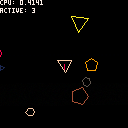
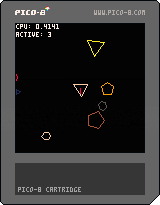
After debugging some physics issues in PICORACER-2048 I decided to make a little area to play around with improving the physics and collisions.
I'm using the "Separating Axis Theorem" to find collisions, and clipping to find the contact points.
Lots of work to do still, many optimisations can be made.
Known issues: contact points are sometimes broken, collision response is not always right.
Optimisations to make:
- cache AABB
- cache world polygons
- don't check AABBs that are not in the same area
- don't check equivalent axes more than once
- remember the previous axis since it's likely to be the same or next to it on the next iteration.
5 comments


Hi everyone,
From some time I wanted to put this project together:
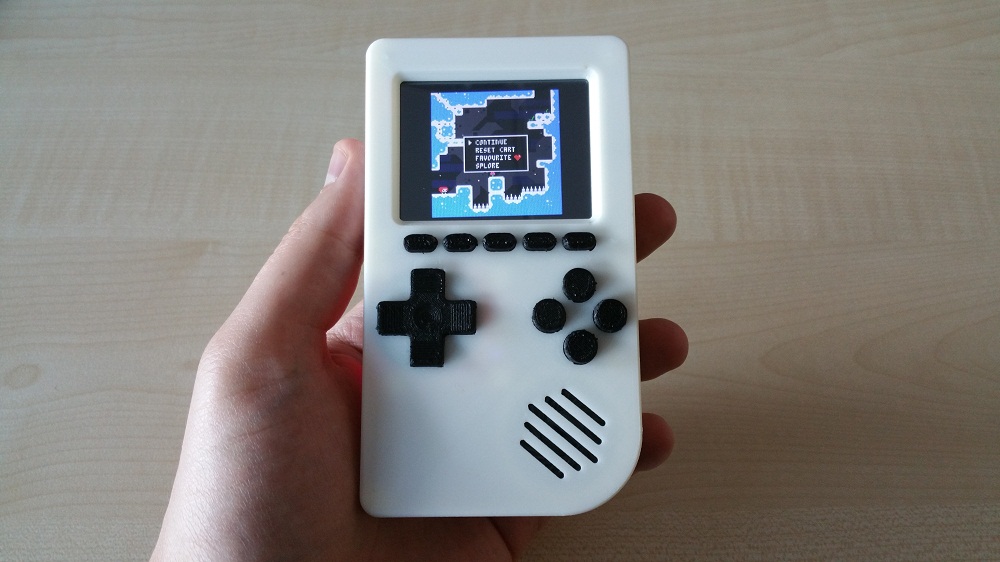
PICO-8 running on Pocket PiGRRL.
Check it out and let me know what do you think in comments below.
All the best,
petri
4 comments
I'm playing with P8 again and for my next game I'd need to get a pixel-perfect collision. Anyone got any samples of that?
6 comments