


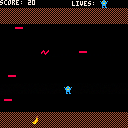


Hey folks!
Today I'm releasing a cool little lib for adding analytics to your PICO-8 game.
You might ask, "wat?" So lemme demonstrate with a quick video:
Essentially, it's a way to track what your players are doing, and to analyze that data afterward for insights. Are players discovering the secret power-up in my game? Are they dying too much, and quitting out of frustration? You can track all of that! And use that information to make your game's design better.
This library sends data to Segment, where I work as a full-time engineer. (I do PICO-8 development as a hobby.) Segment is a badass analytics product that forwards your data to hundreds of tools. For starters, you can turn on Google Analytics in Segment, but there are many other tools in the catalog you can check out.
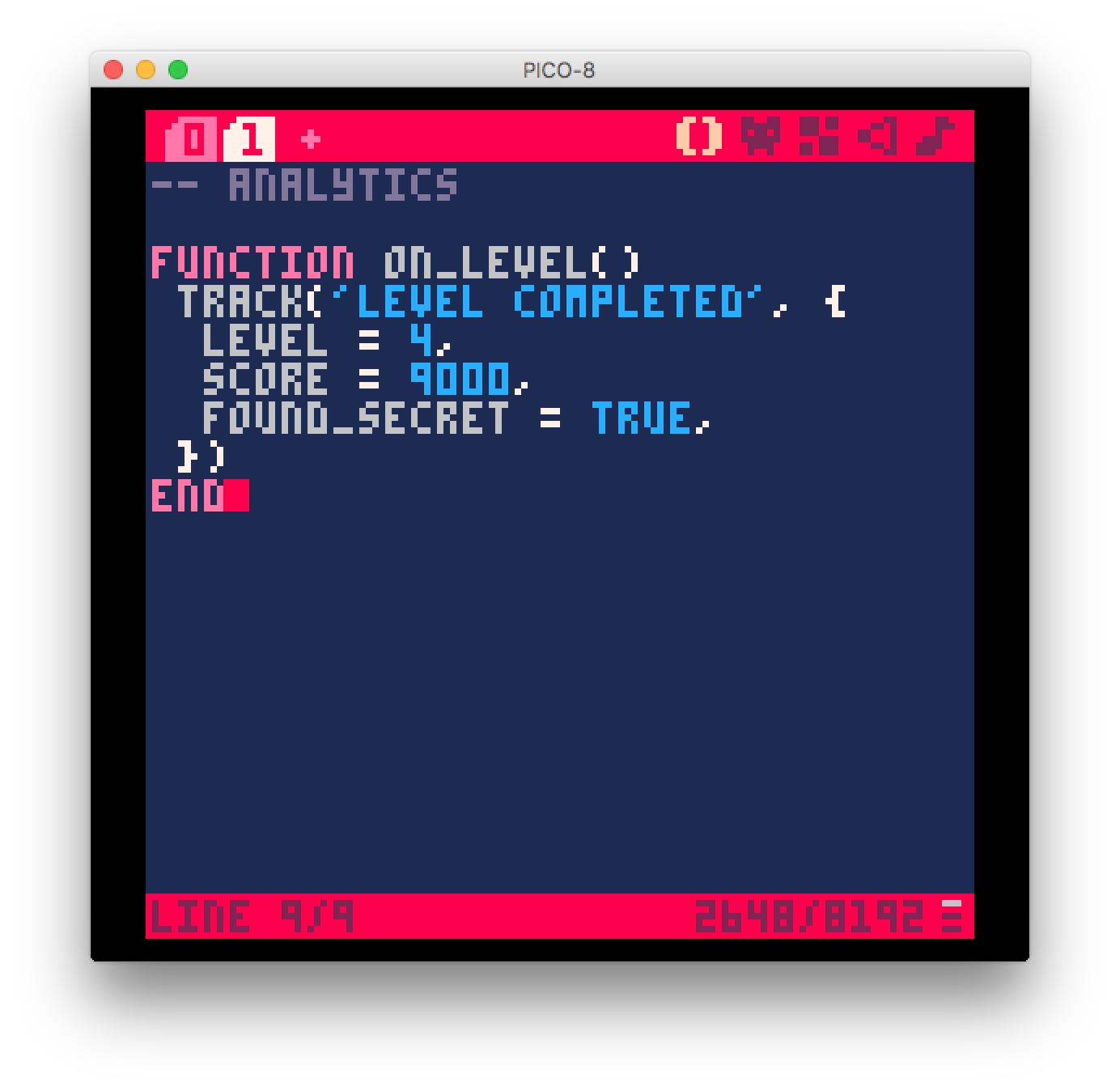
To use it, head on over to the GitHub repo for instructions (https://github.com/segmentio/analytics-pico8). Using it looks something like this:


 1 comment






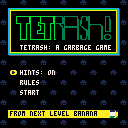
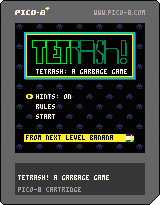
Hi, I made a game about garbage. It's helpful if you live in Portland! Otherwise, um?
(My first time uploading to the BBS, hope I'm doing it right)
1 comment



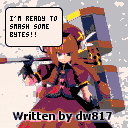
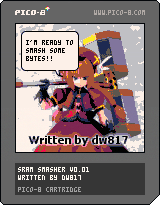
Just like the lady says, this program is ready to smash some bytes !!
Or to be more technical, DWORDS, where a single numeric value is saved in 4-bytes.
from the lab of dw817 comes a
new way of storing sram instead
of just with dget() and dset().
not all data that is recorded
needs to take 4-bytes per
variable leaving you only room
to store 64-numbers.
introducing "sram smasher."
a set of useful routines that
will squeeze your data into a
series of micro bits instead of
single fat 4-byte values.
safeguard ensures sram not
written to unless completely
without user errors.
(Demo values to test the functions is included)
0 comments
I'm working on a utility to help other programmers at the moment (including myself). I am using the compressor my "Image Compressor" uses for raw data but think I can do better.
Didn't someone make a compression program in PICO earlier that used the same fundamentals as PKZIP ?
And if so, does anyone remember where it went ?
8 comments



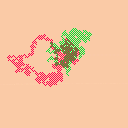
A 2D random walk. Press Z to reset.
At each step, each "walker" will move one step left or right, and another step up or down, with equal probability.
0 comments
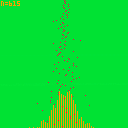
A simulation of the Galton board. Press Z to reset.
At each step, each bean will randomly move left or right. The distribution of the beans when they reach the floor is given by the binomial distribution, which is an approximation of the normal distribution for large values of n (central limit theorem).
1 comment


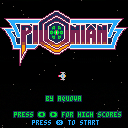
UPDATE 2: I went in and added parallax scrolling! I'm very pleased with how it turned out. This will probably be the final update to the game, as I've now completed everything I was interested in doing.
UPDATE: Based on feedback, I've added the option to add a border or background around the minimap. The option can be seen in the pause menu (press []). I also added a sash that shows what level you're about to begin.
My first real Pico-8 game! It's a clone of the classic arcade game Bosconian, which has always been a favorite of mine. I'm really happy with how it turned out. There's a few things that I might eventually revisit, and the music is sort of terrible, but all and all not bad for my first fully fledged game.
X to shoot,
7 comments


Im adding games to my games front-end (LaunchBox). I can start games sucessfully with:
pico8 -run mygame.p8
But when i end the game, pico stays in the pico console window, and i need to get back to DOS.
Any tips?
3 comments
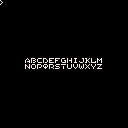
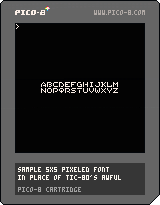
I know there was some talk earlier of the TIC-80 system. I said I thought their 5x5 font was pretty ugly. I still do. Here is what I think would be a better rendition, the font, in part, A-Z. Enjoi !
0 comments
I am definitely seeing a way to store more than 256-bytes at a time.
cartdata("mister_1")

for i=0,63 do
  dset(0,i)
end

cartdata("mister_2")

for i=0,63 do
  dset(0,i)
end
|
And then I'm greeted with this message:
| CARTDATA() CAN ONLY BE CALLED ONCE |
Really ... really ? I mean if you could have multiple Cartdata() commands you could save, well, gee, I don't know, 8192 bytes perhaps ??
Good grief. There's one things in setting limitations in a programming language for nostalgic purposes and then there's just outright imprisoning your data ... 😨
4 comments




Novice coder, so sorry if I'm making a dumb mistake lol.
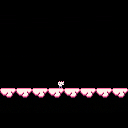
Wanted to make a platformer where the player can shoot and detonate bullets to create platforms that the player can then jump on. However, when that platform is created, using map, the player doesn't collide with it.
I'm using the Advanced Micro Platformer template from mhughson (https://www.lexaloffle.com/bbs/?tid=28793), so I don't really understand where to even start to try to figure this out.
-- config
--------------------------------

--sfx
snd=
{

}

--music tracks
mus=
{

}

--math
--------------------------------

--point to box intersection.
function intersects_point_box(px,py,x,y,w,h)
	if flr(px)>=flr(x) and flr(px)<flr(x+w) and
				flr(py)>=flr(y) and flr(py)<flr(y+h) then
		return true
	else
		return false
	end
end

--box to box intersection
function intersects_box_box(
	x1,y1,
	w1,h1,
	x2,y2,
	w2,h2)

	local xd=x1-x2
	local xs=w1*0.5+w2*0.5
	if abs(xd)>=xs then return false end

	local yd=y1-y2
	local ys=h1*0.5+h2*0.5
	if abs(yd)>=ys then return false end

	return true
end

--check if pushing into side tile and resolve.
--requires self.dx,self.x,self.y, and
--assumes tile flag 0 == solid
--assumes sprite size of 8x8
function collide_side(self)

	local offset=self.w/3
	for i=-(self.w/3),(self.w/3),2 do
	--if self.dx>0 then
		if fget(mget((self.x+(offset))/8,(self.y+i)/8),0) then
			self.dx=0
			self.x=(flr(((self.x+(offset))/8))*8)-(offset)
			return true
		end
	--elseif self.dx<0 then
		if fget(mget((self.x-(offset))/8,(self.y+i)/8),0) then
			self.dx=0
			self.x=(flr((self.x-(offset))/8)*8)+8+(offset)
			return true
		end
--	end
	end
	--didn't hit a solid tile.
	return false
end

--check if pushing into floor tile and resolve.
--requires self.dx,self.x,self.y,self.grounded,self.airtime and
--assumes tile flag 0 or 1 == solid
function collide_floor(self)
	--only check for ground when falling.
	if self.dy<0 then
		return false
	end
	local landed=false
	--check for collision at multiple points along the bottom
	--of the sprite: left, center, and right.
	for i=-(self.w/3),(self.w/3),2 do
		local tile=mget((self.x+i)/8,(self.y+(self.h/2))/8)
		if fget(tile,0) or (fget(tile,1) and self.dy>=0) then
			self.dy=0
			self.y=(flr((self.y+(self.h/2))/8)*8)-(self.h/2)
			self.grounded=true
			self.airtime=0
			landed=true
		end
	end
	return landed
end

--check if pushing into roof tile and resolve.
--requires self.dy,self.x,self.y, and
--assumes tile flag 0 == solid
function collide_roof(self)
	--check for collision at multiple points along the top
	--of the sprite: left, center, and right.
	for i=-(self.w/3),(self.w/3),2 do
		if fget(mget((self.x+i)/8,(self.y-(self.h/2))/8),0) then
			self.dy=0
			self.y=flr((self.y-(self.h/2))/8)*8+8+(self.h/2)
			self.jump_hold_time=0
		end
	end
end

--make 2d vector
function m_vec(x,y)
	local v=
	{
		x=x,
		y=y,

  --get the length of the vector
		get_length=function(self)
			return sqrt(self.x^2+self.y^2)
		end,

  --get the normal of the vector
		get_norm=function(self)
			local l = self:get_length()
			return m_vec(self.x / l, self.y / l),l;
		end,
	}
	return v
end

--square root.
function sqr(a) return a*a end

--round to the nearest whole number.
function round(a) return flr(a+0.5) end

--utils
--------------------------------

--print string with outline.
function printo(str,startx,
															 starty,col,
															 col_bg)
	print(str,startx+1,starty,col_bg)
	print(str,startx-1,starty,col_bg)
	print(str,startx,starty+1,col_bg)
	print(str,startx,starty-1,col_bg)
	print(str,startx+1,starty-1,col_bg)
	print(str,startx-1,starty-1,col_bg)
	print(str,startx-1,starty+1,col_bg)
	print(str,startx+1,starty+1,col_bg)
	print(str,startx,starty,col)
end

--print string centered with
--outline.
function printc(
	str,x,y,
	col,col_bg,
	special_chars)

	local len=(#str*4)+(special_chars*3)
	local startx=x-(len/2)
	local starty=y-2
	printo(str,startx,starty,col,col_bg)
end

--objects
--------------------------------

--make the player
function m_player(x,y)

	--todo: refactor with m_vec.
	local p=
	{
		x=x,
		y=y,

		dx=0,
		dy=0,

		w=8,
		h=8,

		max_dx=1,--max x speed
		max_dy=2,--max y speed

		jump_speed=-1.75,--jump veloclity
		acc=0.05,--acceleration
		dcc=0.8,--decceleration
		air_dcc=1,--air decceleration
		grav=0.15,

		--helper for more complex
		--button press tracking.
		--todo: generalize button index.
		jump_button=
		{
			update=function(self)
				--start with assumption
				--that not a new press.
				self.is_pressed=false
				if btn(2) then
					if not self.is_down then
						self.is_pressed=true
					end
					self.is_down=true
					self.ticks_down+=1
				else
					self.is_down=false
					self.is_pressed=false
					self.ticks_down=0
				end
			end,
			--state
			is_pressed=false,--pressed this frame
			is_down=false,--currently down
			ticks_down=0,--how long down
		},

		jump_hold_time=0,--how long jump is held
		min_jump_press=5,--min time jump can be held
		max_jump_press=15,--max time jump can be held

		jump_btn_released=true,--can we jump again?
		grounded=false,--on ground

		airtime=0,--time since grounded

		--animation definitions.
		--use with set_anim()
		anims=
		{
			["stand"]=
			{
				ticks=1,--how long is each frame shown.
				frames={1},--what frames are shown.
			},
			["walk"]=
			{
				ticks=5,
				frames={1,2,3,4,5},
			},
			["jump"]=
			{
				ticks=1,
				frames={1},
			},
			["slide"]=
			{
				ticks=1,
				frames={6},
			},
		},

		curanim="walk",--currently playing animation
		curframe=1,--curent frame of animation.
		animtick=0,--ticks until next frame should show.
		flipx=false,--show sprite be flipped.

		--request new animation to play.
		set_anim=function(self,anim)
			if(anim==self.curanim)return--early out.
			local a=self.anims[anim]
			self.animtick=a.ticks--ticks count down.
			self.curanim=anim
			self.curframe=1
		end,

		--call once per tick.
		update=function(self)

			--todo: kill enemies.

			--track button presses
			local bl=btn(0) --left
			local br=btn(1) --right

			--move left/right
			if bl==true then
				self.dx-=self.acc
				br=false--handle double press
			elseif br==true then
				self.dx+=self.acc
			else
				if self.grounded then
					self.dx*=self.dcc
				else
					self.dx*=self.air_dcc
				end
			end

			--limit walk speed
			self.dx=mid(-self.max_dx,self.dx,self.max_dx)

			--move in x
			self.x+=self.dx

			--hit walls
			collide_side(self)

			--jump buttons
			self.jump_button:update()

			--jump is complex.
			--we allow jump if:
			--	on ground
			--	recently on ground
			--	pressed btn right before landing
			--also, jump velocity is
			--not instant. it applies over
			--multiple frames.
			if self.jump_button.is_down then
				--is player on ground recently.
				--allow for jump right after
				--walking off ledge.
				local on_ground=(self.grounded or self.airtime<5)
				--was btn presses recently?
				--allow for pressing right before
				--hitting ground.
				local new_jump_btn=self.jump_button.ticks_down<10
				--is player continuing a jump
				--or starting a new one?
				if self.jump_hold_time>0 or (on_ground and new_jump_btn) then
					if(self.jump_hold_time==0)sfx(snd.jump)--new jump snd
					self.jump_hold_time+=1
					--keep applying jump velocity
					--until max jump time.
					if self.jump_hold_time<self.max_jump_press then
						self.dy=self.jump_speed--keep going up while held
					end
				end
			else
				self.jump_hold_time=0
			end

			--move in y
			self.dy+=self.grav
			self.dy=mid(-self.max_dy,self.dy,self.max_dy)
			self.y+=self.dy

			--floor
			if not collide_floor(self) then
				self:set_anim("jump")
				self.grounded=false
				self.airtime+=1
			end

			--roof
			collide_roof(self)

			--handle playing correct animation when
			--on the ground.
			if self.grounded then
				if br then
					if self.dx<0 then
						--pressing right but still moving left.
						self:set_anim("slide")
					else
						self:set_anim("walk")
					end
				elseif bl then
					if self.dx>0 then
						--pressing left but still moving right.
						self:set_anim("slide")
					else
						self:set_anim("walk")
					end
				else
					self:set_anim("stand")
				end
			end

			--flip
			if br then
				self.flipx=false
			elseif bl then
				self.flipx=true
			end

			--anim tick
			self.animtick-=1
			if self.animtick<=0 then
				self.curframe+=1
				local a=self.anims[self.curanim]
				self.animtick=a.ticks--reset timer
				if self.curframe>#a.frames then
					self.curframe=1--loop
				end
			end

		end,

		--draw the player
		draw=function(self)
			local a=self.anims[self.curanim]
			local frame=a.frames[self.curframe]
			spr(frame,
				self.x-(self.w/2),
				self.y-(self.h/2),
				self.w/8,self.h/8,
				self.flipx,
				false)
		end,
	}

	return p

end

--make the camera.
function m_cam(target)
	local c=
	{
		tar=target,--target to follow.
		pos=m_vec(target.x,target.y),

		--how far from center of screen target must
		--be before camera starts following.
		--allows for movement in center without camera
		--constantly moving.
		pull_threshold=16,

		--min and max positions of camera
		--the edges of the level.
		pos_min=m_vec(64,64),
		pos_max=m_vec(320,64),

		shake_remaining=0,
		shake_force=0,

		update=function(self)

			self.shake_remaining=max(0,self.shake_remaining-1)

			--follow target outside of
			--pull range.
			if self:pull_max_x()<self.tar.x then
				self.pos.x+=min(self.tar.x-self:pull_max_x(),4)
			end
			if self:pull_min_x()>self.tar.x then
				self.pos.x+=min((self.tar.x-self:pull_min_x()),4)
			end
			if self:pull_max_y()<self.tar.y then
				self.pos.y+=min(self.tar.y-self:pull_max_y(),4)
			end
			if self:pull_min_y()>self.tar.y then
				self.pos.y+=min((self.tar.y-self:pull_min_y()),4)
			end

			--lock to edge
			if(self.pos.x<self.pos_min.x)self.pos.x=self.pos_min.x
			if(self.pos.x>self.pos_max.x)self.pos.x=self.pos_max.x
			if(self.pos.y<self.pos_min.y)self.pos.y=self.pos_min.y
			if(self.pos.y>self.pos_max.y)self.pos.y=self.pos_max.y
		end,

		cam_pos=function(self)
			--calculate camera shake.
			local shk=m_vec(0,0)
			if self.shake_remaining>0 then
				shk.x=rnd(self.shake_force)-(self.shake_force/2)
				shk.y=rnd(self.shake_force)-(self.shake_force/2)
			end
			return self.pos.x-64+shk.x,self.pos.y-64+shk.y
		end,

		pull_max_x=function(self)
			return self.pos.x+self.pull_threshold
		end,

		pull_min_x=function(self)
			return self.pos.x-self.pull_threshold
		end,

		pull_max_y=function(self)
			return self.pos.y+self.pull_threshold
		end,

		pull_min_y=function(self)
			return self.pos.y-self.pull_threshold
		end,

		shake=function(self,ticks,force)
			self.shake_remaining=ticks
			self.shake_force=force
		end
	}

	return c
end

function fire(direc)

	local b = {
		sp=16,
		x = p1.x - 4,
		y = p1.y - 16,
		dx = direc,
		dy = 0
	}

	add (bullets, b)
	isdetonate = false

end

function detonate(x,y)
 	local d = {
			x = x + 4,
			y = y + 4,
			t = 0,
			timer = 0,
		}
		add(det, d)

		detx = d.x
		dety = d.y

 for b in all (bullets) do
		del(bullets, b)
	end
		isdetonate = true;
end

function draw_bullets()
	if(p1.flipx == false) then
		direction = 1
	end
	if(p1.flipx == true) then
		direction = -1
	end

	for b in all (bullets) do
		spr(b.sp, b.x, b.y)
	end
	for d in all (det) do
		circ(d.x, d.y, d.timer/2, d.t)
		circ(d.x, d.y, d.timer/2 - 4, d.t)
	end
end

function draw_clouds()
		map(0,62,detx - 8,dety - 4,2,2)
end

function update_bullets()

		for b in all (bullets) do
			b.x += b.dx
			b.y += b.dy
		end

		if(btnp(4) and isdetonate) then
			fire(direction)
		end
		if(btnp(5) and isdetonate == false) then
			for b in all (bullets) do
				detonate(b.x, b.y)
			end
		end

		for d in all (det) do
			randcol = flr(rnd(2))
			if(randcol == 0) then
				d.t = 14
			end
			if(randcol == 1) then
				d.t = 7
			end

			d.timer += 1
			if (d.timer == 20) then
				del(det, d)
			end
		end
end

function delete_bullets()
		for b in all (bullets) do
			if(b.x > cam.pos.x + 64 or
			b.x < cam.pos.x - 64) then
				del(bullets, b)
				isdetonate = true;
			end
		end
end

--game flow
--------------------------------

--reset the game to its initial
--state. use this instead of
--_init()
function reset()
	ticks=0
	p1=m_player(64,40)
	p1:set_anim("walk")
	cam=m_cam(p1)
	bullets = {}
	isdetonate = true
	det = {}
	randcol = 0
	playerx = 0
	playery = 0
	direction = 1
	detx = 500
	dety = 500

end

--p8 functions
--------------------------------

function _init()
	reset()
end

function _update60()
	ticks+=1
	p1:update()
	cam:update()
	--demo camera shake
	update_bullets()
	delete_bullets()
end

function _draw()

	cls(0)
	camera(cam:cam_pos())

	map(0,0,0,0,128,128)

	p1:draw()
	draw_bullets()
	draw_clouds()
	-- debug
	-- camera(0,0)
	-- circ(cam.pos.x, cam.pos.y, 2,7)
	-- printc("adv. micro platformer",64,4,7,0,0)
	-- print(cam.pos.x)
end
|
1 comment
I was reading in the instructions something called, "breadcrumbs." I'm thinking this might be something like Gretel used to mark the path home out of the forest.
Can someone please explain how these are worked into PICO-8 and their usage ?
6 comments


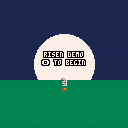
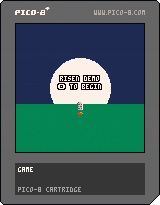
Description
Death is not the end of this knight's quest. This is a short demo of a game I've been working on for a bit now.
Instructions
Directional Keys move your character.
Hold the O Key to charge up, release the O Key to attack.
Hold the X Key to use your shield. The shield recharges when not in use.
Version
The current version is 1.0 and features the following changes:
+release
Thank you for playing my game!
3 comments

I have noticed Pico-8 does not seem to load files with the UTF-8 BOM.
I think it would be a useful feature to add in the future. Sometimes, when I am not on my own computer, I happen to make some changes on Windows Notepad and I have to remove the Unicode BOM before loading the cartridge.
0 comments

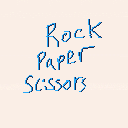
The first complete game I have made.
It's pretty basic and silly, but hey I made it all by myself!
2 comments
