


With the new version of Pico8 you can use 4 diffrent CARTDATA-Ids to store 1000 bytes.
But what can you do, when you need more? This demo-file stores 1k bytes (16 cartdata-ids!) of data.
How it's work:
The Run-command does the trick. It restart the cartridge, reset the cartdata-ids-usage (and other stuff, like music) and you can pass a command line (even in the web-version). Sadly it erased every variable BUT it does not erase the free memory (0x4300 to 0x5fff and 0x8000 to 0xffff). So simple store there your complete gamedata and use "RUN".
The magic happen at the beginning. The code checks if a command line was passed to the cartridge. In the commandline is encoded what to do, which memory-adress should be saved, how many bytes and which "baseid" should be used.
It simple calls a series of cartdata and memcpy to save or load the data. When more than 4 ids are needed, it re-"run" the code with a updated command line.
When all data is saved or loaded, the variable "resume" is set to "true".


 3 comments


Rural Rampage - Final Update!:
Hey all!
The game is in a state that I consider ready for general playing enjoyment! Let me know your thoughts (and be nice to me, this is my first Pico 8 project lol).
I'm excited to start this journey in game creation! Pico 8 is such a fun platform and I'm stoked to get more familiar (and clean my code up).


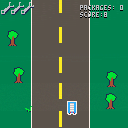

Rural Rampage - Update 1:
1 comment
.webp)
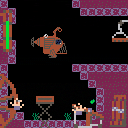

I finished my first pico-8 game, more like an execise than a game but i still like it, if you happen to se a floating bone around make sure to capture it and post it here, its very rare!
8 comments


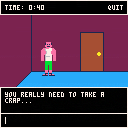

Made in two days for the PVGD Pico Jam 2025.
Demake (remake?) of the classic flash game Don't S*** Your Pants by Cellar Door Games.
Try to get all the awards :)
Instructions
Type commands, and don't crap your pants.
If you're stuck, try LOOKing at things.
Changes
For posterity, here is the version as it was at the end of the jam.
Since then, there have only been these changes:
- Awards are now persistent using cartdata. Also added a "reset" command on the main menu to clear awards.
- Added some situations around farting that weren't handled correctly.
1 comment



Horizon Glide
Battle through infinite isometric worlds in this arcade hover-ship shooter!
About
Horizon Glide is an infinite isometric arcade shooter where you pilot a hovering ship through endless procedurally generated landscapes. Navigate dynamic terrain, manage your ammo, and survive against enemy forces in this unique blend of exploration and combat.
Features
- Procedurally generated infinite worlds - Every playthrough is unique
- Isometric 3D perspective - Classic arcade viewpoint built entirely in PICO-8
- Dynamic terrain generation - From water levels to mountain peaks
- Combat system - Battle enemy ships while managing limited ammo
5 comments






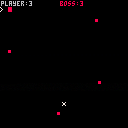


A game for the PVGD Pico-8 Jam 2025 by Jonny D.
Fly through the stars, picking up aliens and taking them quickly to their destination! Flying into asteroids is not advised.
Uses Speako8 to inform and taunt you.
3 comments


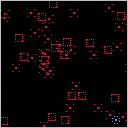

A tiny anxiety inducing game. Press the direction of the green object and don't fumble under pressure
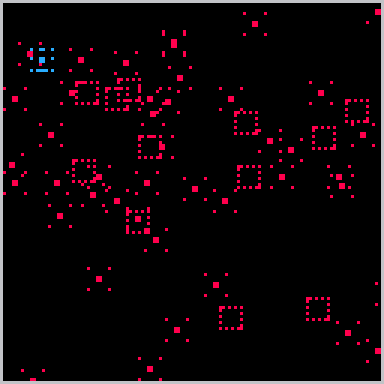
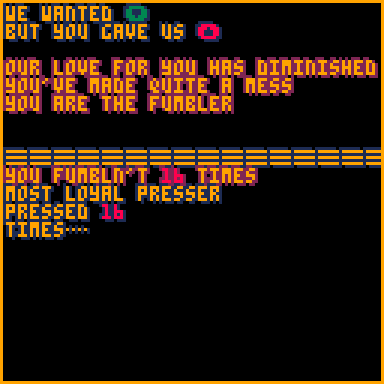 2 comments



DoorNotes
My First Cartridge!
This is my first cartridge, a simple silly song. I wanted to test to see if I could have sound effects playing in sync. I don't know if it is the best way to do that, but I was happy that I got it to work.
Controls
The arrow keys open and close the doors.
0 comments
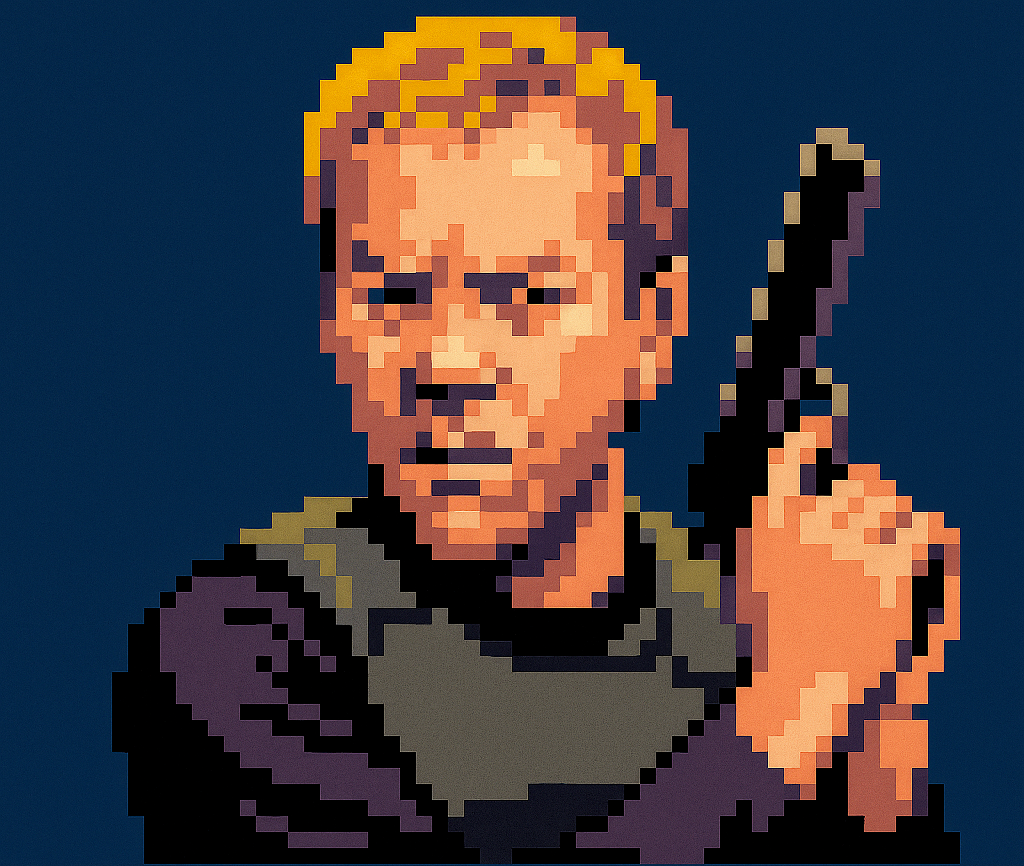


Spy vs spy demake
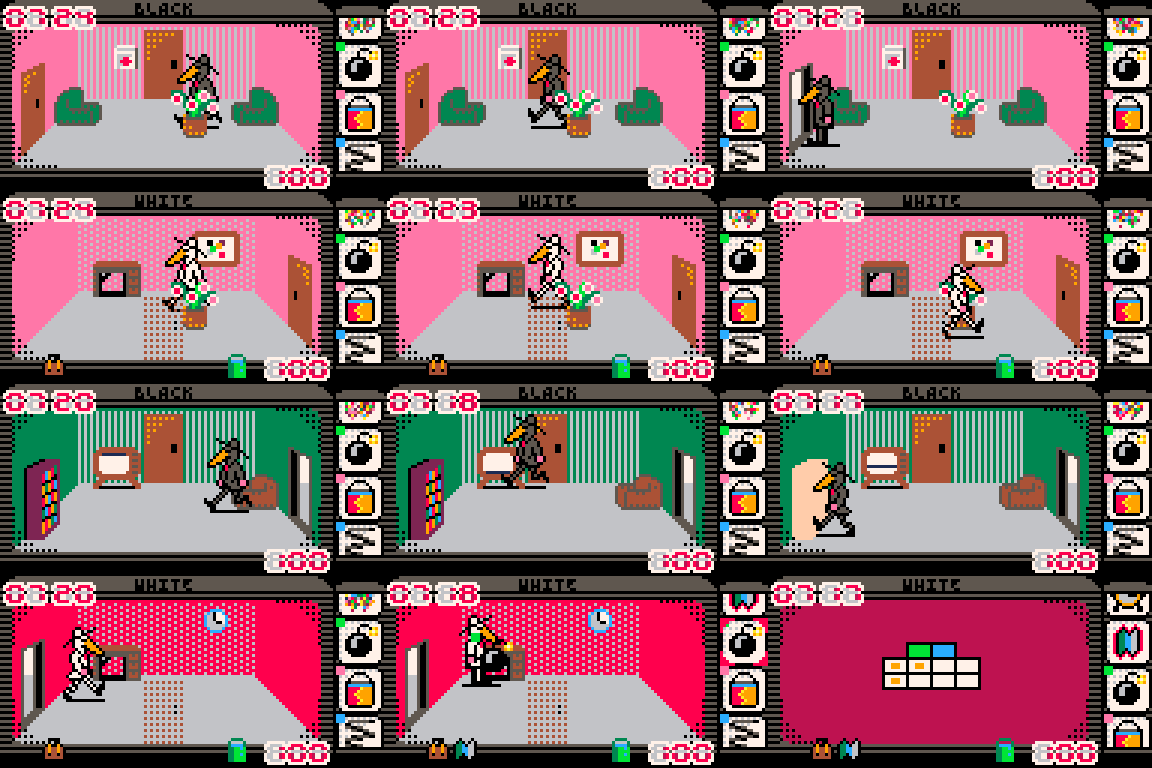
One mission. One rival. One survivor.
Game overview
A faithful retro demake of the classic console/computer spy duel.
Collect all five secret items and escape through the airport before your rival.
Set traps to slow him down, and find antidotes to avoid his tricks.
Search furniture, outsmart your opponent, and be the first to get away!
26 levels available.
Play against human or computer.
Any feedback/suggestion is welcome.
Controls
Exploration mode
ARROWS: Move inside rooms
X: Search for items
5 comments




My first project!
No doubt this has been done before way more elegantly but for a first go at anything coding, I am quite pleased with my attempt.
0 comments


This is a P8 adaptation of a "Rainbow Magazine" type-in video game called "Penguin Icarus" by Nick Bradbury for the Tandy Color Computer 3. Although the level layouts are different the game play is mostly the same, but faster and with more sound effects, particles and more. The code has not been optimized!
You are a penguin in envy of the other small birds and the large metal birds that fly high in the sky and dream of one day flying...
2 comments


General Instructions:
Use your hammer to build buildings on the power grid, but be careful. Not every power cell on the grid can support a building! Use the number clues and marked off cells to figure out where buildings can be placed on the grid. Carefully check the grid to see if it's online, but each check will cost you energy. Once the energies run out, you won't be able to bring anymore grids online. This tiny nonogram puzzle game has endless grids to solve, with new ones every time you play!
10 comments



A classic vertical shoot-em-up reminiscent of a famous space war movie. Written and created by a 9-year-old with the help of his dad.


v2025.7
The following changes have been introduced:
- Leaderboard for high scores
- Help modified
4 comments



I'm running Pico-8 0.2.7. When I use the underline P8SCII code together with the double-wide character P8SCII code I get an interrupted line.

Also, while we are discussing P8SCII interactions, here are two odd behaviors that could also be intended behavior:
-
Double-tall P8SCII code doesn't make the underline two pixels tall. I would have expected it to be so, but I would understand if this was intended.
- Outline doesn't seem to be drawn around the underline. Personally, I would prefer if it did get drawn around every foreground pixel.
 0 comments



There's nothing like being a snail ridin' through a tunnel.
If you want to play this, just ask!
P.S. I'm working on Snail's Gold 2 and this is a filler.
0 comments


Simple, interactive demo of a custom masking technique I was playing around with for fun.
A good example of an application of bitwise logic in computer science!
← and → to change the background fill to emulate changing opacity
(x) [x] to toggle masking effect
(o) [z] to show only the mask layer
The pulsing background is drawn into screen memory at 0x6000.
Shapes and background fill for the mask layer are drawn into memory at 0x8000 with color 15.
Four bytes each from 0x6000 – 0x7FFF and 0x8000 – 0x9FFF are compared with a bitwise AND operation (band()) and the result is written directly to screen memory.
There's not a lot to it besides that, but I thought it looked cool and wanted to share.
0 comments