



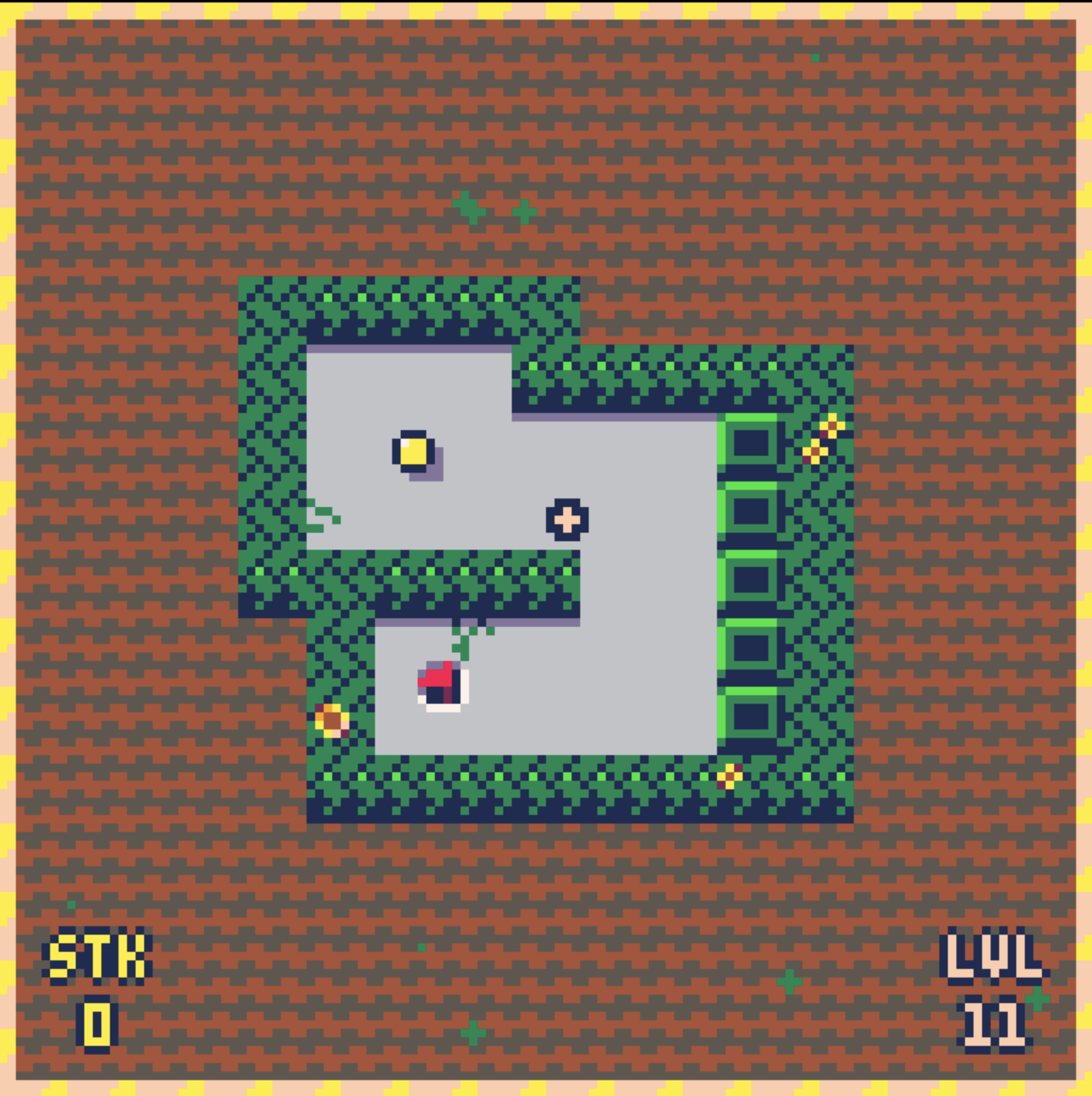
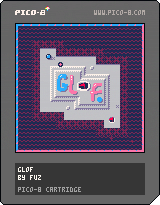
After some feedback, I have redesigned slopes and one certain feature (that was not well received) and added 15 new levels! Now including world 4, and a bonus world with 5 challenging levels! Glof is still unfinished, however I am ready to move onto a new project, but if you have any suggestions still drop them here!


 2 comments


Hi there!
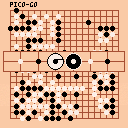
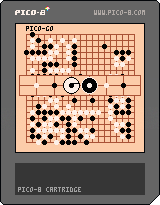
I've made an (almost) fully-featured Go board game for the Pico-8 inspired by this tweetcart by Munro. Feel free to submit any bug reports if you encounter any weird behaviors.
Features:
- Auto capture
- Suicide restriction on placing pieces in eyes
- Piece capture counter
- Illegal placement feedback (cursor flashes red and won't allow you to make an illegal move)
- Awesome design - entirely thanks to Munro
I'm still a bit new to the game of Go, so I may have missed a few rules I'm not aware of, feel free to let me know if there's something I should add.
Planned features:
- Auto-scoring
- Pre-defined rulesets
0 comments


I'M LOOKING FOR A GAME
A GAME OF SOME YEARS AGO WHERE YOU SHOULD WALK FOR STAGE DIFFERENTS, IT WAS ABOUT A HIGH MAN WHO WAS FOLLOWING FACTS OF BLOOD AND THE END FIND A MONSTER EATING A PERSON. I PLAYED IT ON THIS PAGE MAKES ENOUGH TIME AND THE GAME IS OUT OF HERE BUT I COULDN'T FIND IT AGAIN.
PLEASE!! I WANT TO PLAY AGAIN THIS GAME.
I DON´T SPEAK ENGLISH BUT A HOPE THIS IS UNDERSTOOD.
3 comments

Is it golf? Is it not golf? It's glof!!!!!!
After spending the past week on this game I have something playable! 30 levels and 3 worlds, and 8 different mechanics!
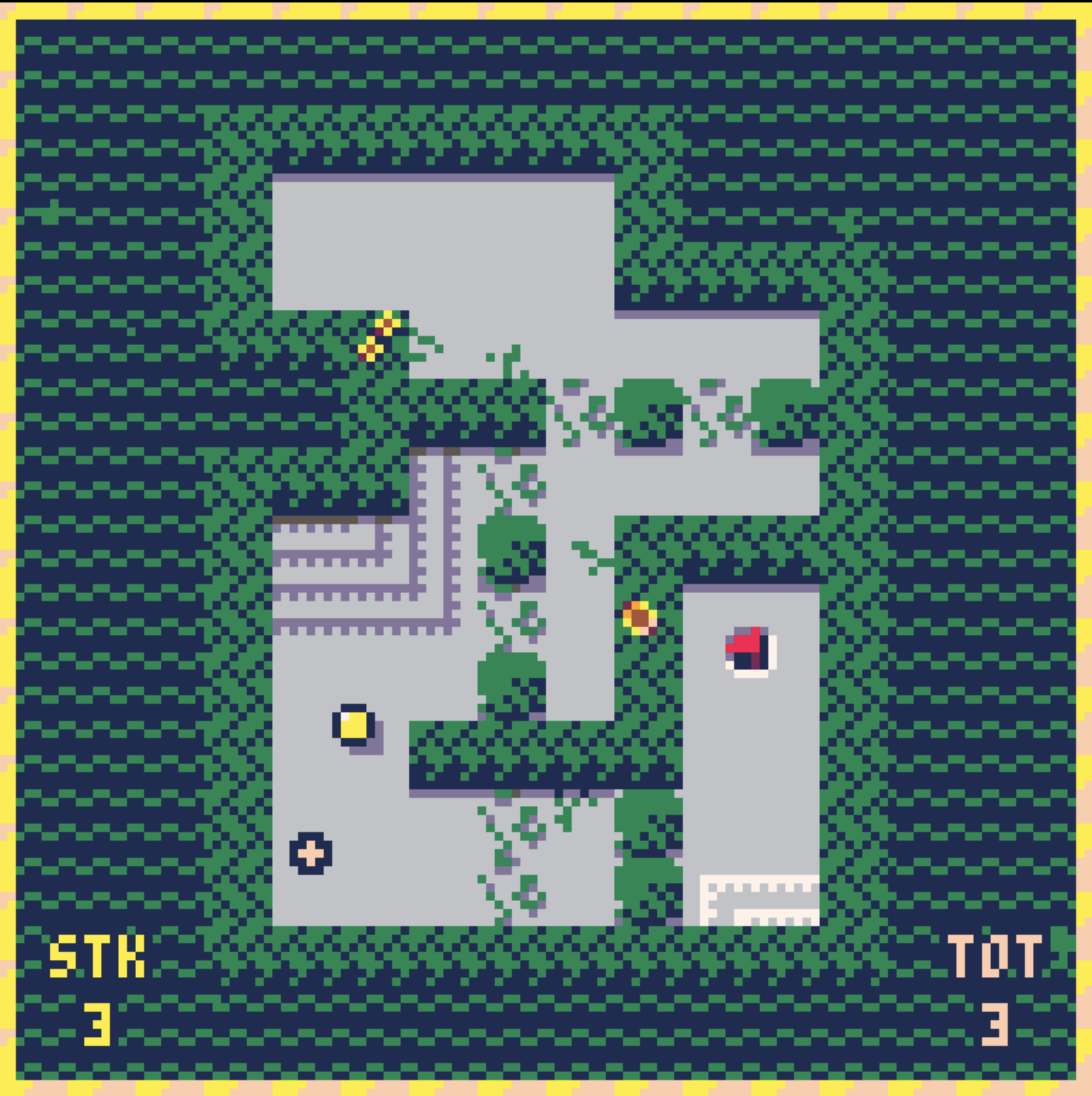
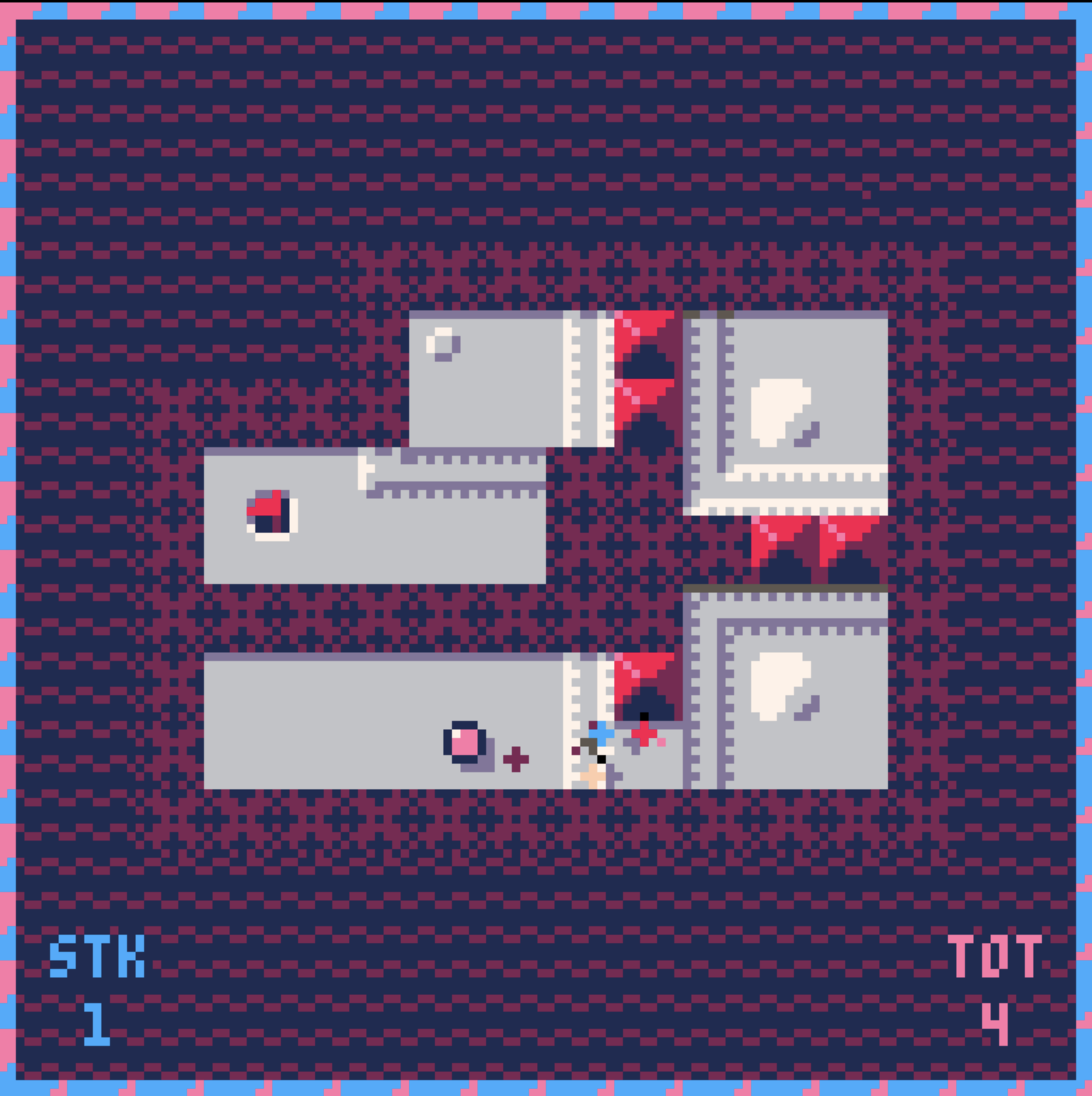

This game is very unfinished, so if you encounter any issues or have feedback/ideas for the future, please comment them here.
Have fun!
3 comments





HELLLLLLLLLLLLLLLLLLO!
This is my first post, tomorrow I'll be uploading a game on here! Not my first one by any means but, still!
Pleasure meeting all of you!
0 comments


Hello all!
I'm Styx. I'm just starting out learning Lua and P-8 stuffs!
Nice to meet you ^^
 2 comments

.png)

Hi friends,
I'm struggling to create a simple pendulum motion. I'm just trying to get a pixel to move along an arc and swing back. If I understand correctly, I need an angle variable that oscillates between .25 and .75. Right now, my angle variable ("a") oscillates between 1 and 0. How do I modulate the angle so it bounces between .75 and .25?
x,y=63,63

function _update()
         a = abs(time()/2 % 2-1)

	 x=x+sin(a)
	 y=y+cos(a)
end

function _draw()
        cls()
	pset(x,y,7)
end |
6 comments



Sorry, I'm stop make new games and i'm deleted my games
Check my new account https://www.lexaloffle.com/bbs/?uid=125952
2024-2025
3 comments



I'm a newbie and I'd like to learn procedural generation to add things like dynamic grass and vegetation to my game. I really like how Zep created the swaying trees in the fireflies gif for the 0.2.4 release, so I thought I'd examine his code. But I'm having some trouble parsing it because the function seems to call itself. I'm assuming this is what's called a recursive function.
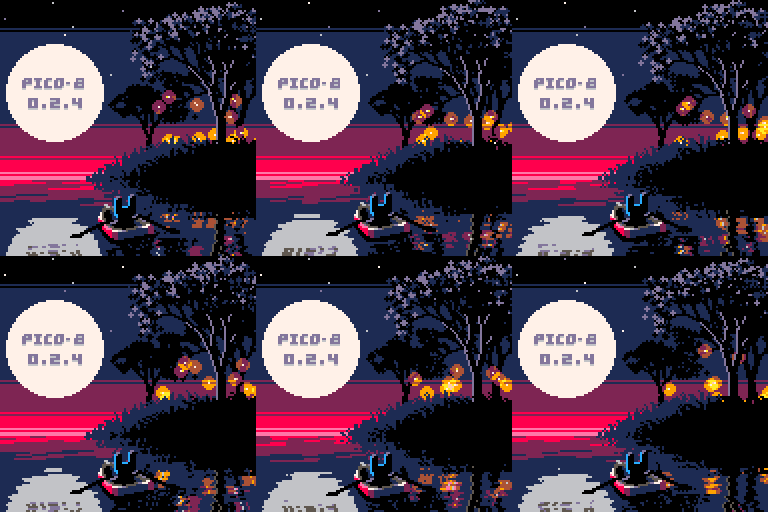
How does the function know to stop calling itself? I'm guessing the if statement regarding the l variable terminates it but how? I'm confused because, to my mind, logically, there should be an "else" following the if/then to call the function again. What is the point of the return command?
Here is his function for drawing the trees:
function tree(x,y,a,l)
 if (l<3) then

  for ii=0,3 do
   circfill(
	   x+rnd(8)-rnd(8),
	   y+ii,
    1,lcol[4-ii])
  end

  return

 end

 local x1=x+cos(a)*l
 local y1=y+sin(a)*l

 local q=l/8
 local col=l>8 and 13 or 0
 for xx=-q,q do
  line(x+xx,y,x1+xx,y1,col)
  col=0
 end

 local d=
 (
  cos(t()/3+x1/50)+
  cos(t()/4+x1/70)
 )/500

 tree(x1,y1,d+a-.04-rnd(0.04),l*(.9-rnd(0.2)))
 tree(x1,y1,d+a+.04+rnd(0.04),l*(.9-rnd(0.2)))

end |
Thanks!
2 comments


I'm new to the BBS and new to Pico-8 as well. I've been obsessed with the concept since I first became aware of it around four months ago. Everything about it fires every happy neuron in my autistic brain and I now own four different handheld emulators which I use almost exclusively for playing Pico-8 games.
I cut my teeth on coding back in the 80s when I was in high school, but trying to write games in BASIC was a disappointment and the only other viable option at the time was learning machine language coding, which terrified me. If Pico-8 had existed back then, my mind would have been blown, and my life would have ended up very differently.
I'm finally sitting down and going through the "Shmup for Pico-8" tutorial from the very beginning. I really like the fact that each installment has a homework assignment. I want to be able to take an idea for a game and be able to say with confidence, "Yeah, I think I can make this happen."
0 comments