




Hi everyone,
I'm converting a few userdata objects from "f64" to "i16" to do some bit-manipulating on it (for example for testing clipping flags and things like that).
The "convert" operation seems to be quite costly, though. I guess that's mainly because it's returning a new userdata object:
local new_data_i16= existing_data_f64:convert("i16") |
However, the documentation shows a "dest" parameter which is not further mentioned but it looks to me as if it could write the data into an existing userdata object:
userdata:convert(data_type, [dest]) Return a copy of userdata cast as a different type. When converting to ints, f64 values are flr()'ed and out of range values overflow. |
No matter how I turn this syntactically, it doesn't result in a filled "dest" object.
Can someone maybe shed some light on how this is meant to work or is this parameter for something completely different?...


 0 comments
Hi everyone,
I'm using sspr to select small regions from a bigger sprite atlas.
Since I have many sprites to draw, I'm trying to render userdata-batches just like it's possible with tline3d and spr, too.
Unfortunately I can't get it to work. Maybe the parameter format is different?
Here is a very simplified example:
set_spr(1, sprite)   -- "sprite" is userdata "u8" 64x64

-- fill sspr-parameters into userdata
batch:set(
       0,0,
       1, 0,0, 64,64, 90,60, 64,64, 0)

sspr(  1, 0,0, 64,64, 20,20, 64,64, 0)  -- this works, draws a 64x64 sprite at 20,20
rect(20,20, 20+64,20+64)                -- rect to show where it's expected

sspr( batch )                           -- some thing with batch - does nothing
rect(90,60, 90+64,60+64) -- debug rect (empty...) |
Tried "batch" with 9, 10 and 11 components because I wasn't sure about the flip-flags.
Did I miss something?...
2 comments
Hey everyone,
we're finally cleaning up the sources of our demo The Mind from last year's Revision party.
Each effect will be available as a standalone file with a bit of comments added.
If you want to know more, please let me know.
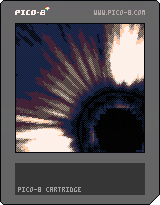
This effect is a classic ray-casting tunnel. It's doing a ray-cylinder intersection test along a rough grid and interpolates the areas in between. By replacing the intersection test, you can render all kinds of continous shapes.
Since the uvs of the cylinder wrap around at some point, a bit of thought went into solving this in a reasonably performant way.

Source code
1 comment

Hey everyone,
we're finally cleaning up the sources of our demo The Mind from last year's Revision party.
Each effect will be available as a standalone file with a bit of comments added.
If you want to know more, please let me know.
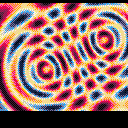
This effect is a classic interference effect as it was seen in many Amiga demos of the early 90s.
The idea was to keep it simple so it would run at 60 FPS and add some palette flashing and screen bouncing, which was a signature look back in the days and syncs well with music.
The performance comes from always writing 8 pixels at once into the screen with poke4.
Source code
2 comments

Hey everyone,
the Revision demoparty had a "fantasy console" competition this year where we showed a Pico-8 demo.
Since it's using multi-cart, you can only watch it online at the moment.
And for those interested, the complete source code is available in the download archive on Pouet.
(On Windows it seems to run better in Firefox than in Chrome)
There's also a Youtube video.
And a video showing our approach to the music.
Have fun and let us know what you think!
You can also load and run it in Pico8 with
load #themind1 run |
This will sequentially download all required data carts (which takes a couple of seconds) from the BBS and stores them in local storage.
That works fine in Pico8 Edu for example.
1 comment


