


Tips
Common Raking Patterns
The key to solving tricky gardens is to have a strong repertoire of raking maneuvers up your sleeve. After a while, you will start to get a feel for which moves are going to help and which ones might get you stuck. There is no substitute for experience, but have a look over these common raking patterns for some ideas.
 |
 |
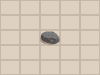
The Empty Corner Empty corners are easily dealt with. Simply rake out smaller corners until there are none left. |
 |
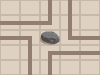 |
The Lone Rock In order to rake around a lone rock, try to approach the rock from each of its four sides. |
 |
 |
The Long Rock Long rocks are easier to deal with, because you have enough space to walk up to them, turn around, and come back. |
 |
 |
 |
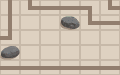
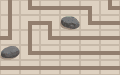
The Pair of Knights It is often useful to wiggle between two rocks like this by walking into the first rock, and then turning into the second. |
 |
 |
The Loop This is a less obvious maneuver, but is very useful. Look for empty paths in the sand which are 2 squares wide. It is possible to walk around the edge of the path and come back. |
 |
 |
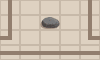
The Kink If there is a rock set one square into sand, consider walking into the rock and then turning. |
 |
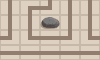 |
The Circuit Similar to the Kink, it is possible to rake all the way around a rock in this this situation. |
Unsolvable Configurations
Every time you rake a new section of sand, there is a chance that you have just made the puzzle unsolvable! It is useful to be able to quickly determine if this is the case so that you can go on to explore a different approach, rather than spending time on a red herring. Also, it means that you can rule out certain moves before you have made them, if you can see that you will produce one of the following patterns:
|
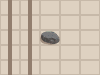
1. Rock Against a Flat Edge The most common way to leave the puzzle unsolvable is by raking in a straight line next to a lone rock. No matter how you approach the rock, you will always leave a rock in the corner (2) or a dead end (4). |
|
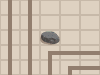
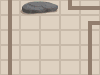
2. Rock In The Corner Attempting to approach such a rock will always leave a dead end (4). Unless there are other nearby rocks, leaves or ornaments that allow you to rake around the corner, this configuration is unsolvable. |
|
3. Odd Width Section Unless a rectangular section of sand is very shallow, it must be an even number of squares wide. Any attempts to rake such a section will eventually produce a dead end (4). |
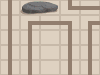
| 4. Dead End All monks who enter shall perish. |


